
Once upon a time, there were one-speed and two-speed automatic transmissions — can you say Chevy Turboglide, Powerglide, and Ford-O-Matic? We knew that you could. At their introduction, they were fairly useless for any performance application. Then came gearboxes like the C4 and C6 and the Turbo 350 and 400, etc., until overdrive automatics started taking over in the 1980s. Now GM and Ford both offer a 10-speed and it’s no slushbox, but U.S. Shift has just released a controller, the Quick 10, to help you perfect it.
Enthusiasts were overjoyed at having four-speed overdrive transmissions in their late-model muscle cars, like the 5.0 Mustang, third-gen F-bodies, and ’84-up Corvette, etc. Soon, the hot rodders wanted these overdrives in their steeply geared street machines. The aftermarket took notice and began offering upgrade kits to fortify the Ford AOD and GM 2004R and 700-R4, which were quickly followed by full-on swap kits.
Then came electronic four-speed ODs and the next thing you know, there were six- , seven- , eight- and nine-speed automatics hitting the market, though not all were great for high-performance applications.
Somewhat surprisingly, Ford and General Motors combined their efforts to produce a cutting-edge 10-speed automatic. In Ford speak, it is called the 10R80, or 10L90 in GM land, and it debuted in 2017. As good as the 10-speed twins are, enthusiasts are seeking them out and retrofitting them into their hot rods.
But as good as it is, the 10-speed can definitely be better. On the street in normal driving conditions, it can get confused because it reacts so quickly to inputs. Just pulling away from a traffic light can put you in Third or Fifth gear before you know it, whether you want to be or not.
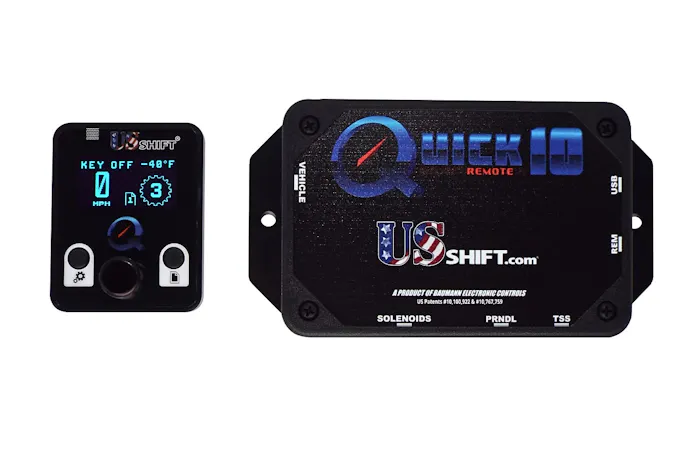
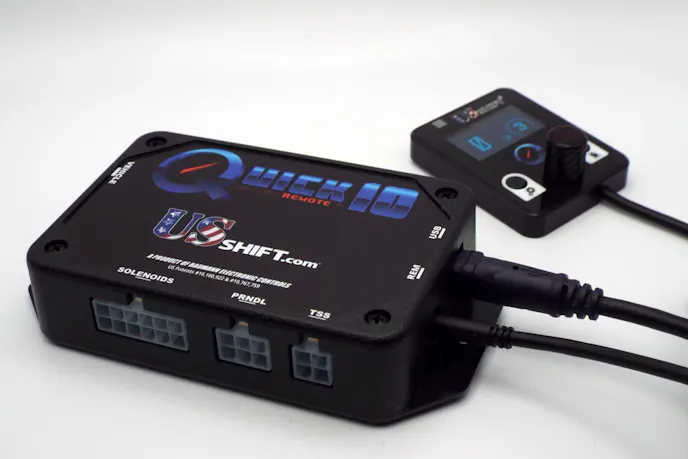
The Quick 10 is a powerful, fully-featured, and easy-to-use transmission controller based on U.S. Shift’s Revolution architecture. It enables the use of an electronic 10R80 transmission on a wide variety of vehicles that lack the OEM capability, such as classic cars, trucks, or motorhomes. It can also be used to enhance a modern vehicle’s performance by taking over control from the OEM computer, allowing the user to directly adjust shift points, firmness, torque converter engagement, and much more.
What Needs Improvement
Naturally, like any OE product, there is plenty of room for improvement. That is where U.S. Shift steps in. Its new Quick 10 Controller improves numerous aspects of the 10-speed gearbox in retrofit applications.
“The development process has been extensive since with 10 gears, many downshift combinations are available, and with so many shifts occurring as you drive, poor shift quality is far more irritating than it would be in a four- or six-speed transmission,” according to US. Shift. “As a result, during this development process of several years, we have completely redesigned the controller hardware and have upgraded much of the controller firmware, as well as the tuning software.”
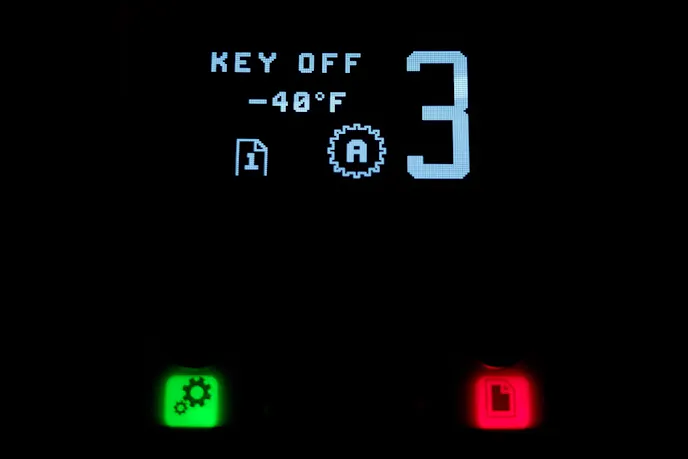
Anyone who owns a stock late-model vehicle with one of these gearboxes (watch the author raise his hand) knows the 10R80 cracks off quick, firm shifts at the track, and it also does an admirable job of downshifting in autocross/spirited driving situations.
But as good as it is, the 10-speed can definitely be better. On the street in normal driving conditions, it can get confused because it reacts so quickly to inputs. Just pulling away from a traffic light can put you in Third or Fifth gear before you know it, whether you want to be or not. Pedal pressure changes can have it up- or downshifting so fast that if you change your mind, the trans (and computer) can’t keep up with your inputs.
This is where the Quick 10 demonstrates its abilities.
”Some of the benefits we have enabled in Quick 10 are improved and more extensive shift-learning capability for quick, smooth, and consistent upshifts, self-tuning downshift with improved shift quality, and new predictive algorithms to optimize downshifts for the quickest and most responsive power-on downshifts possible,“ they told us. ”With so many speeds available, it is imperative to downshift to the desired gear as quickly as possible with minimal steps. We have optimized the downshift process to leverage the capabilities of these transmissions to their full potential. We have also worked to optimize the smoothness of these downshifts for the best experience possible.“
10-Speed Benefits
While some would ask if you really need 10 forward speeds in a non-over-the-road truck application, we can say from personal experience that it would be hard to go back to a six-speed or four-speed auto after living with a 10R80. Once you get used to it, the benefits become clear. Its shifts are fairly seamless in day-to-day driving, but it really shines when you stick your boot in it.
Quick, hard shifts at redline are the norm. With the close gear spacing, your engine is always on the boil during acceleration, even after shifts at higher gears and speeds. If you choose to use the paddle shifters on winding roads, the upshifts and downshifts are rapid and fun.
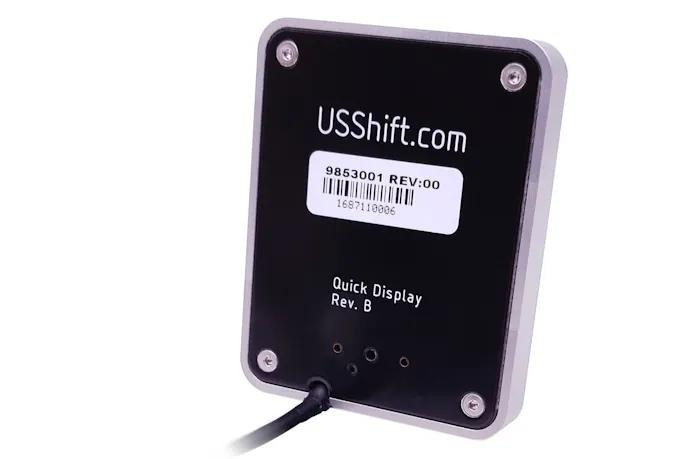
With a low 4.696:1 first gear and and three overdrive ratios (0.854, 0.689, and 0.636:1) you can tailor your rear gear ratio for both maximum acceleration and quiet and economical cruising. Certainly, those who have 4.56 and 4.88 reared gears in their automotive history will appreciate the 4.696:1 first gear. A set of 3.55s or 3.70s is all you’ll probably need for the average street machine.
Since the gear ratios are so close, engine RPM drop during each shift is minimal, enabling shifts to complete quickly and smoothly. You are never far from peak torque after a gear change, either.
Perhaps best of all, according to U.S. Shift, the stock transmissions can handle at least 600 horsepower, with modified units supporting four-digit power levels. In this day and age, when 600-1000 horsepower is commonplace, these transmissions are more desirable than ever for cars that didn’t come with overdrive —or any new street muscle build for that matter.
Six Questions About The Quick 10
We spoke to Jackson “Jake” Chandler at U.S. Shift about the Quick 10 and asked these questions about the unit.
1. Are there different programs you can download with it or is it all up to the end user? Or both?
Both. Our tuning software contains several baseline tunes. We write a calibration before it’s shipped based on the customer’s vehicle description. Typically, with our patented self-learning and automatic tuning algorithm, the base tune is all they need once the controller learns and auto adjusts shift quality over the first several miles of driving. That being said, virtually every aspect of shifting (firmness, WOT RPM shift points, light throttle shift points, and converter clutch lockup) can all be adjusted by the customer if they desire.
2. Are the safety parameters built in that will prevent over-enthusiastic or inexperienced people from hurting their transmissions?
Yes, for the most part. We have strict warnings and documentation stating that you must allow the transmission to self-tune at light throttle initially until you feel the shifts are “normal.” We also clearly state to not drive the vehicle if any error codes are displayed. The only way someone could hurt their trans would be to whack full throttle immediately after install in a relatively high powered application without giving the control adequate time to self-tune the individual shift pressures during light throttle driving.
Also, as with any high powered hot rod with an enthusiastic driver, I’m sure you of all folks are aware that things break occasionally. It’s also up to the customer to ensure the transmission has upgraded hard parts if their power level requires it. Beyond that, our Quick 10 system offers the best diagnostics capability of any controller and a “shift in progress” signal wire that can connect to an aftermarket ECU for torque reduction purposes.
3. Is the Quick 10 designed more for the guy with a late-model car or the 10-speed swapped car? What are the biggest benefits for both?
Quick 10 is primarily for swaps into vehicles that were never originally equipped with a 10-speed clutch-to-clutch automatic transmission. Generally, OEM late-model applications can have the transmission tuned via the ECU. However, our system can be useful in late-model vehicles that have significant engine modifications, aftermarket fuel injection, and/or and engine swap.
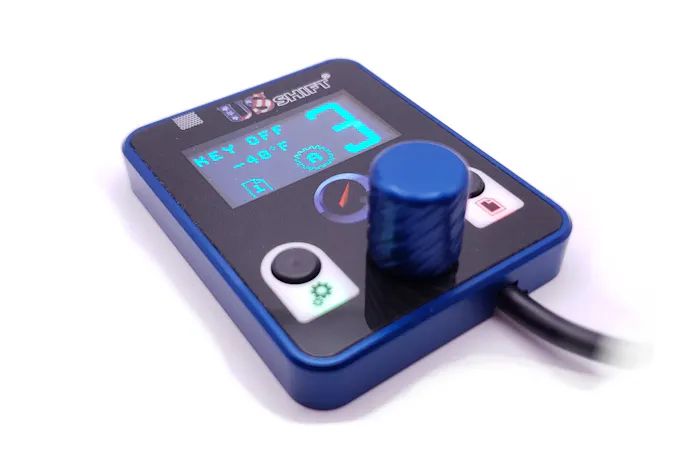
clear anodized (silver in color), black anodized, blue Anodized, or red anodized
4. When will the GM version of the programmer be available?
Karl [Baumann, the company’s owner] is currently developing the GM version in his 1999 Trans Am LS test mule. There will be updates and Youtube videos in the future, but I cannot provide you with a definite availability date range at this time. Just know he’s actively working on it, and believes it will go fairly quickly due to much of the development already being completed through the Ford version.
5. What are the biggest problems with these transmissions from the factory and how can the Quick 10 help alleviate them?
While there are a few updated internal parts developed since the intro in 2018 (we will eventually have a comprehensive list), there really aren’t any serious issues or problems with these 10-speed units. As to how Quick 10 can help alleviate OEM problems, it is primarily with the overall shift quality and scheduling. With our system, there is no “hunting” and the trans always seems to be in the perfect gear for whatever your right foot is doing.
6. What is the retail price?
Retail is $1,475 for the complete kit including remote display and full vehicle wiring harness with OEM style connectors.
You might also like
1965 Plymouth Satellite 440-Plus Six Packs A Punch
Kenton, the second owner, was lucky enough to score a complete, running 440 Six-Pack out of a totaled '71 Charger R/T