
Just when you thought it was safe to go back in the garage, along comes MEGAZILLA 2.0!
No, this is not a sequel to a Japanese horror flick. Quite the opposite. Megazilla 2.0 is the newest and most powerful crate engine ever from Ford Racing, a 1,200-horsepower drop-in piece of equipment that is guaranteed to try and separate the rearend from the rest of your car.

Once upon a time, 450 horsepower was lot, then 550 made it seem uninteresting. Then came 700, 800 and 1,000 horsepower street machines. Now, Ford Racing has almost doubled the output of its original Megazilla crate engine, and that will have people running and screaming everywhere.
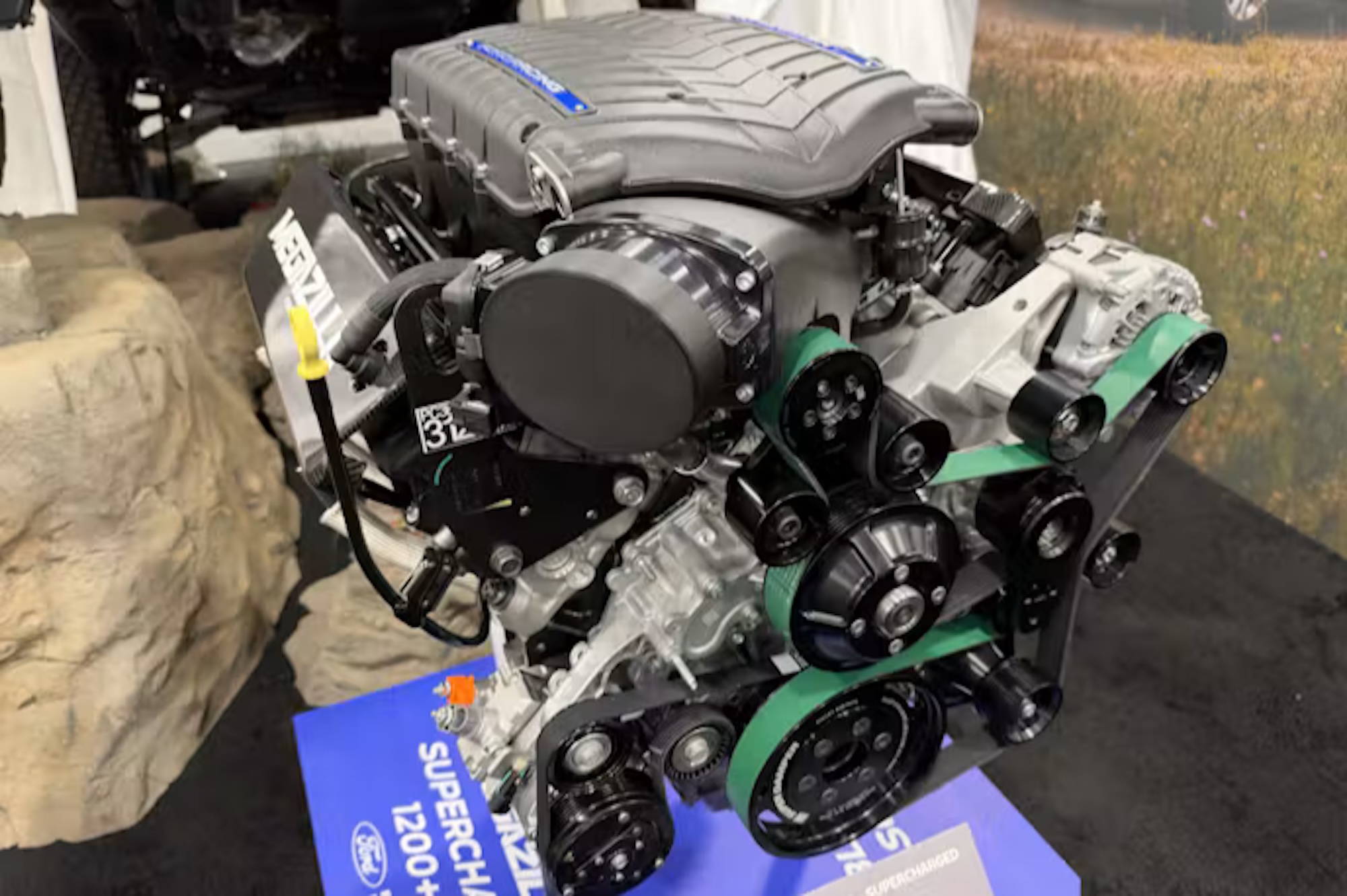
Back in 2022, Ford Racing unleashed its Megazilla crate engine, a 615-horsepower version of the Godzilla 7.3-liter V8 that is optional in Super Duty pickups. That engine remained naturally aspirated, but several upgrades enhanced its durability and performance. At this year’s SEMA Show, Ford Racing showcased the supercharged Megazilla 2.0 crate engine in the Frostwarden Bronco build. Megazilla 2.0 is Ford’s most powerful crate engine yet.


Not Just A Blown Megazilla
With more than 1,200 horsepower and over 1,000 lb-ft of torque, Megazilla 2.0 (P/N: M-6007-MZ73MD) is the most powerful crate engine ever created by an automaker. However, this isn’t a case of bolting a supercharger onto the original combination. Ford Racing developed the latest version with a stronger block, forged pistons, revised valvetrain hardware, and the airflow of a massive Whipple supercharger.
“It’s been said that I’m really the father of Megazilla. Now we’re on to 2.0. There was obviously a 1.0 that came before it, but what we wanted to do was build a crazy, four-digit-horsepower 7.3-based engine,” Michael Goodwin, Ford Racing Parts Product Manager, said. “I tasked the engineering team with making me at least 1,200 horsepower using the 7.3-liter platform, and they’ve really delivered.”

The centerpiece of that performance is a Gen 6 3.0-liter Whipple supercharger, supported by a dedicated boost-specific camshaft, forged pistons made from a new alloy, and larger fuel injectors. Ford also developed a new 10-rib front-end accessory drive system and revised the belt drive and damper to handle the demands of the supercharged combination.
“This isn’t just Megazilla 1.0 with a supercharger bolted onto the top. It had its own separate development program,” Goodwin said. “We upgraded a lot of components, and the block has some machining differences.”
Internally, those upgrades include Mahle forged pistons (delivering a 10.5:1 compression ratio), Callies H-bean connecting rods, and a custom Ford Racing camshaft. Meanwhile, ARP 2000 head studs seal the CNC-ported aluminum heads to an improved block (P/N M-6010-SD73R).
Additionally, block changes address cylinder sealing, a critical consideration when pushing a large-displacement engine into four-digit horsepower territory. The production 7.3-liter block features a saw cut between the cylinders to help with cooling. Ford eliminates that cut during Megazilla 2.0 machining to improve sealing between the cylinders.
“The block itself is a very good foundation for high-performance builds. It’s a deep-skirt design, and each main cap has six bolts: two on the sides and four underneath,” Goodwin said. “Everything is checked to make sure it meets our specified tolerances. Any block that doesn’t meet those checks is rejected and isn’t used in an assembly.”
What To Put It In
Its architecture and compact dimensions are part of what makes the Godzilla family attractive to those building classic machines where packaging modern engines can be a challenge. Add 7.3 liters of displacement and the resulting torque, and the appeal is obvious. It can go in anything from an early Mustang or Torino to a classic F100 or full-size Ford.

“The 7.3 is a narrower overhead-valve architecture, and with all those cubic inches, it makes phenomenal torque,” Goodwin said. “That makes it a natural candidate for trucks and street rods. We even built a Galaxie convertible with one. It’s a great engine foundation for a lot of different projects.”
You might also like
Speedway Motors Debuts GM A-body Chassis At SEMA Show
It now features a trick Speedway Motors G-Comp full chassis, designed to maximize performance and handling in the ’68-’72 GM A body platform.