
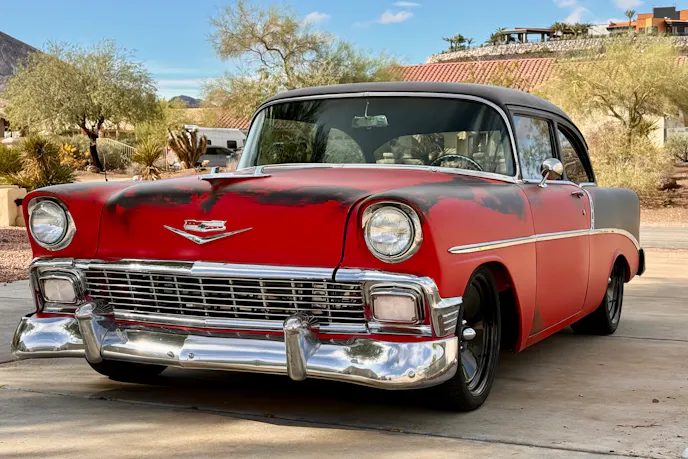
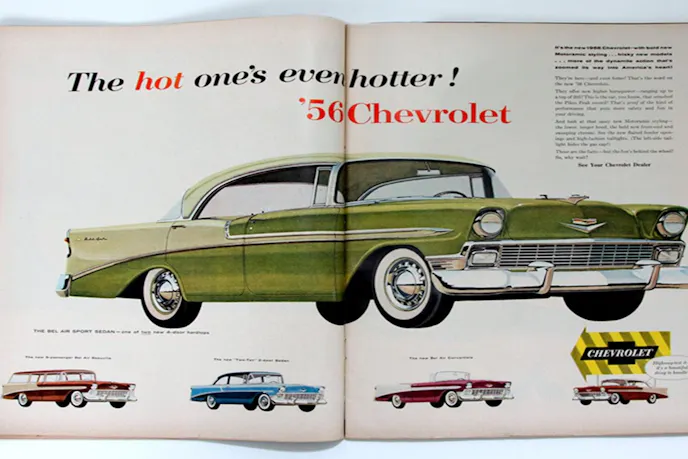
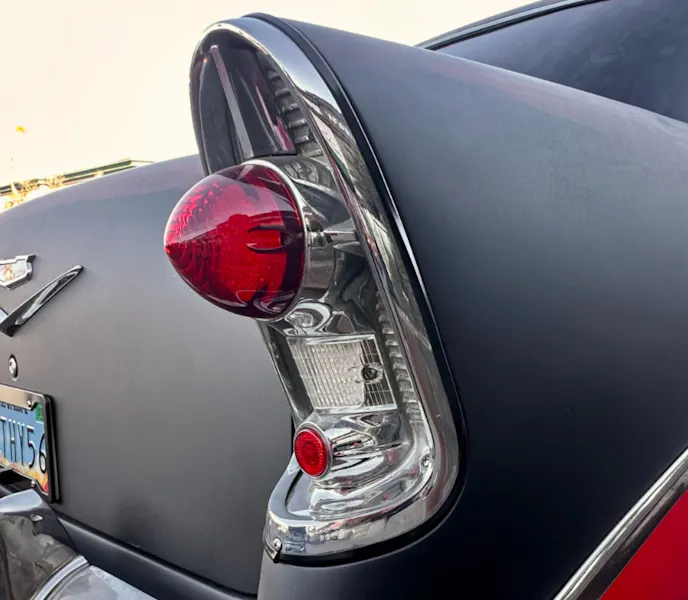
Scarce few cars have hit legendary status in automotive history like the 1956 Chevy. Sittin’ at the center of the Tri-Five Chevy era, the ’56 expanded on Chevrolet’s 1955 “The Hot One” advertising campaign. Chevrolet marketed the ’56 as “Even Hotter.” Its iconic profile is what caught the eye of Mike C. when he uncovered the restomod project version of his red-hot shoebox.
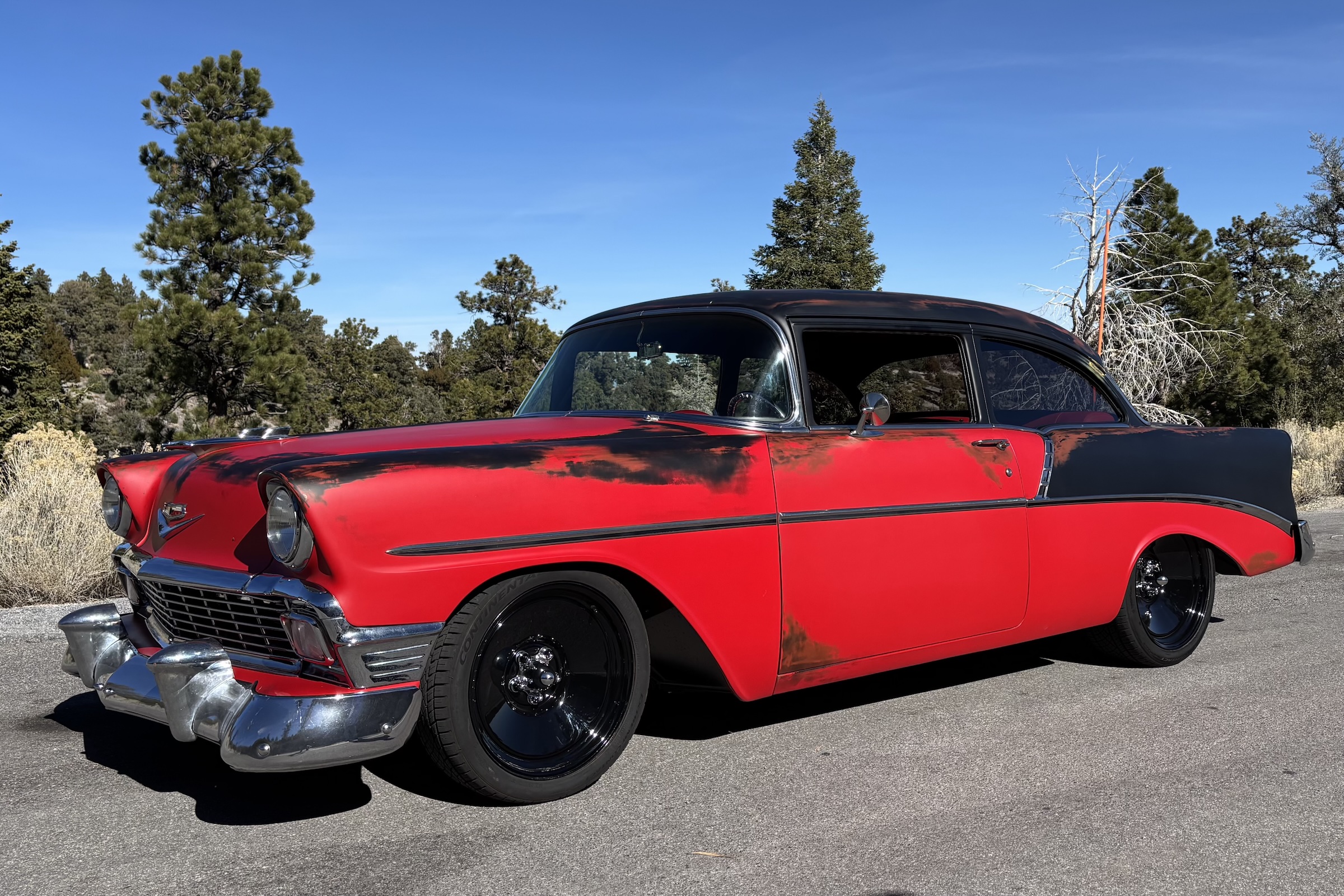
Found baking in the high desert sun of California’s Apple Valley, this red and black 1956 210 was the focus of a quick negotiation. For only $500, the two-tone treasure was the field-find of the decade. More than a half-century after it rolled out of the Los Angeles (Van Nuys) assembly plant, Mike’s rocket-quick nine-month build reclaimed the Chevy 210’s classic Tri-Five swag and put another survivor of America’s automotive golden age back on the road.
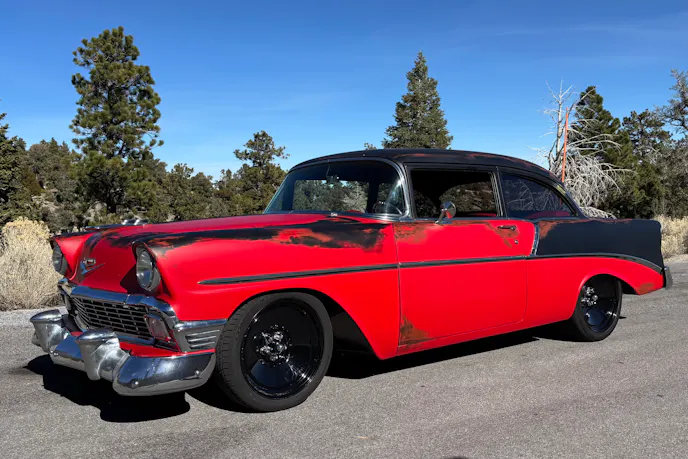
Years earlier, the 1956 Chevy 210’s owner had begun its resurrection as a full body rotisserie redo. For unknown reasons, it was painted and then forgotten. It sat untouched for 17 years.
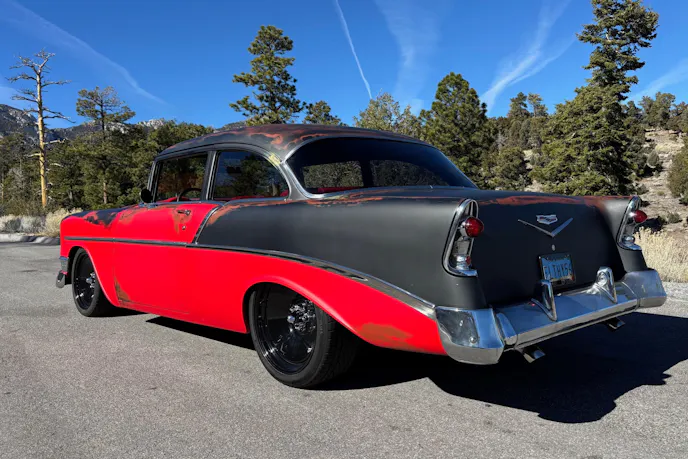
“They just sat it on a chassis with two bolts in it,” recalled Mike. “There was no motor, but the guy had a title.”
After digging the car out with a winch, Mike loaded the two-door sedan into an enclosed trailer, took it home, and started peeling it apart. Putting it back together was when the fun began.
Factory V-8 To LS Swap
In 1956, Chevrolet gave customers multiple engine-transmission combos to choose from. Power on the low end came from the Blue-Flame 6-cylinder at 140-horsepower. Mid-range was the Turbo-Fire V-8 at 162-horsepower. And the high-end option was the Super Turbo-Fire V-8 with 205 horsepower.
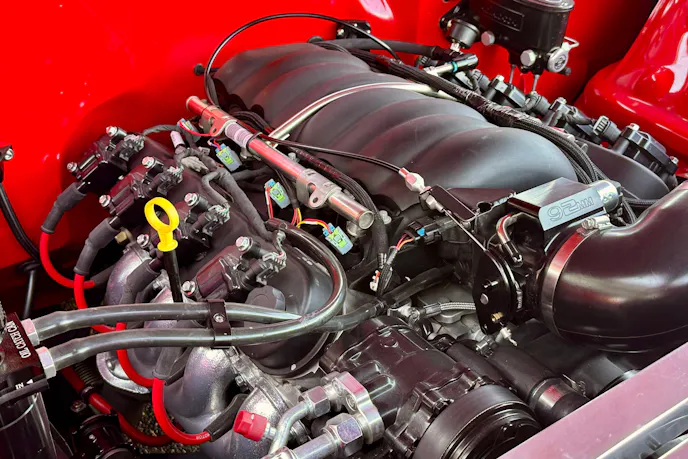
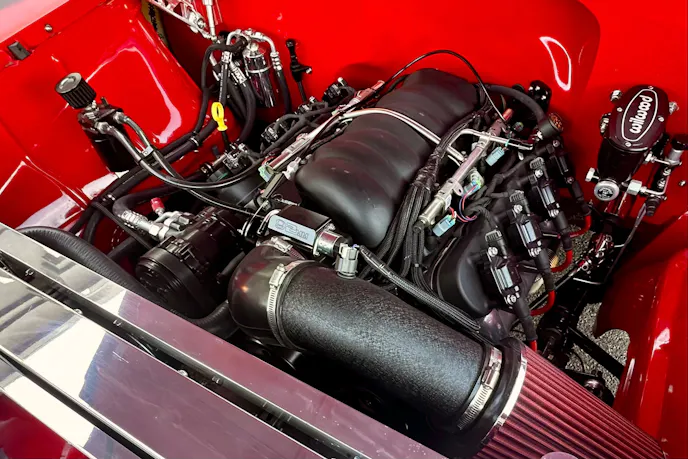
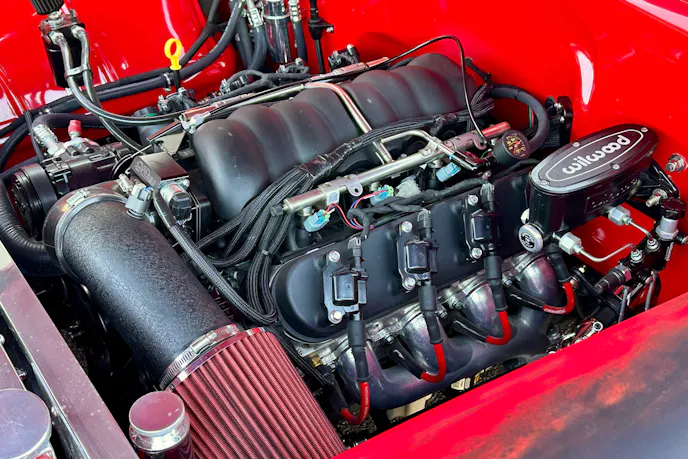
The door post plate on Mike’s 210 reveals that originally there was an eight-cylinder under the hood, but of course, he was looking for more horses than the factory had offered. His new powerplant was a 6.2-liter, naturally-aspirated Gen IV small-block V-8 with an all-aluminum block and heads.
“The engine was an LS3 out of a Chevy SS,” said Mike. “I’m an LS guy and I will never do another carburetor, but the LS used to cost less. We used to be able to get them all day for $4,000 to $5,000. Now if you can find them, you’re looking at $7,000 to $10,000.”
LS Power With A 4L60E Upgrade
Soon after the initial shakedown, the Chevy’s LS swap forced an upgrade to the rest of the drivetrain. Before break-in was a wrap, the standard 4L60E transmission Mike used just couldn’t keep up.
“I didn’t really know the transmission or have any history on it,” he said. “Within 500 miles, I blew it up. The car was dyno’d at right about 490-horsepower, and the torque was up there at 400-405.”
Mike ended up outsourcing the tranny. He had the same one rebuilt and beefed up to handle a 500- to 600-horsepower motor.
“Within three months, I had 2,700 miles on it,” he said.
Exhaust runs through 2.5-inch stainless to the MagnaFlow muffs. When considering headers for the LS’ exhale, Mike chose to keep the engine bay clean and tight.
“I like Holley [manifolds] because they simulate the regular exhaust manifolds but run a little better and you don’t have all the studs coming out, like from the factory,” he explained.
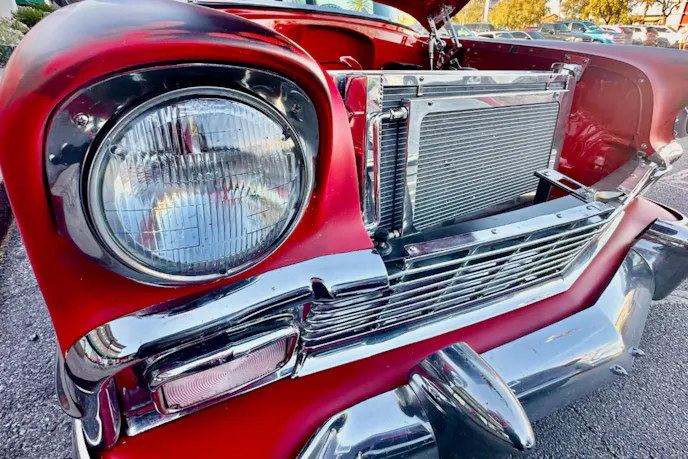
The polished-aluminum radiator came from Mattson’s Customs. Their built-to-order Tri-Five package includes dual SPAL 13-inch electric fans. ”They do a lot of stuff for me and it’s a kit, so it’s just easy,” added Mike.
Pro Touring Chassis, Suspension and Brakes Modernize The Tri-Five
To balance power and cruisability, the ’56 Chevy was built with a Ford nine-inch Currie rearend with 3.50:1 gears. The Chevy’s pro touring Tri-Five chassis came from Graham’s Hot Rod Shop and included QA1 shocks and springs.
“Everything on it, even the spindles, is QA1,” said Mike. “It was customized to me, whatever I wanted and it’s just so fun. There are no tricks. I can get the keys, start it up and just go. It feels like a modern driver.”
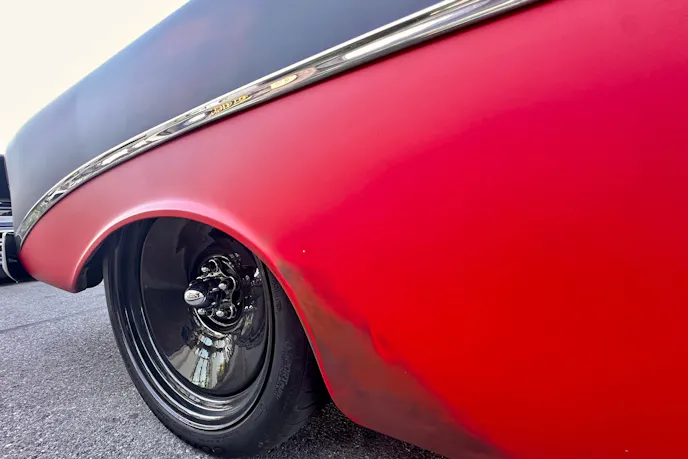
Transforming the classic’s stopping power into a modern feel, a Big Brake disc conversion put Wilwood’s all-around, drilled and slotted with six-piston caliper fronts and four-piston caliper rears. To fit the vintage look, the simple, understated wheel design was chosen from U.S. Mags. The staggered stance comes from 18-inch wheels on the front and 20s on the back.
“I really wanted to put Schott wheels on it, but I couldn’t come out of pocket $10 grand for them,” he said. “These are something simple.”
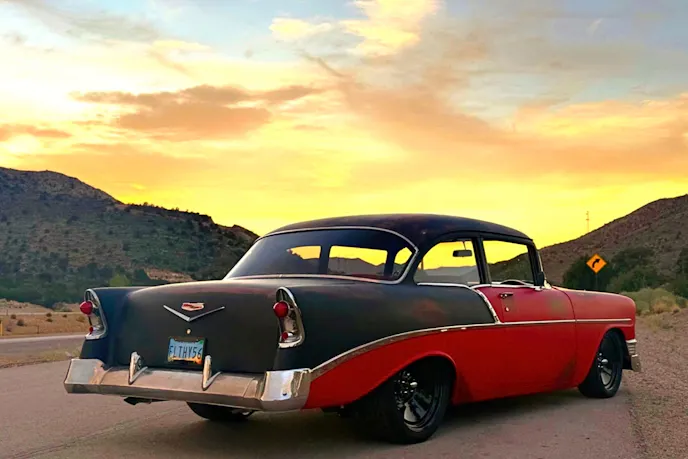
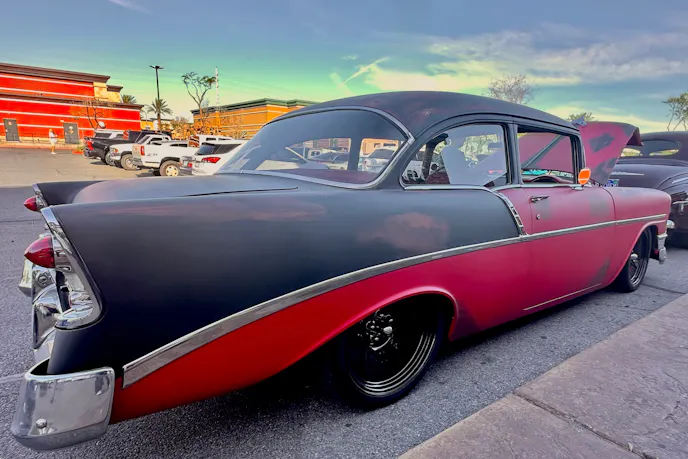
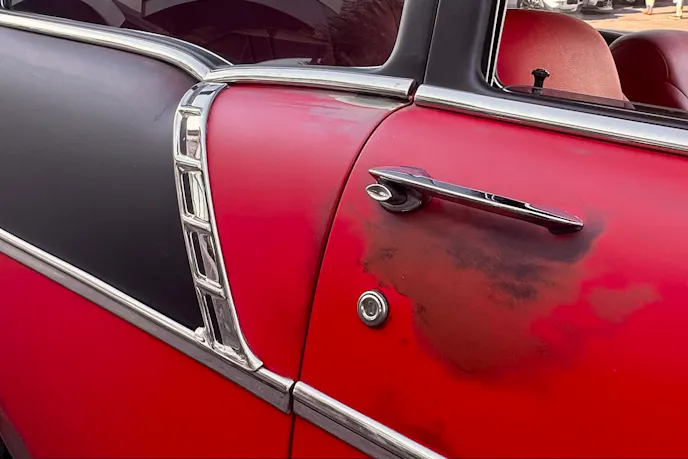
The ’56 Chevy’s red and black tuxedo was intact when Mike picked it up. Leaning into the OG vibe, he decided to pass on an ice cream paint job. It was his first venture into patina, and he was all-in on the idea. He estimated he used five different colors blended for the look and a matte clear to finish it.
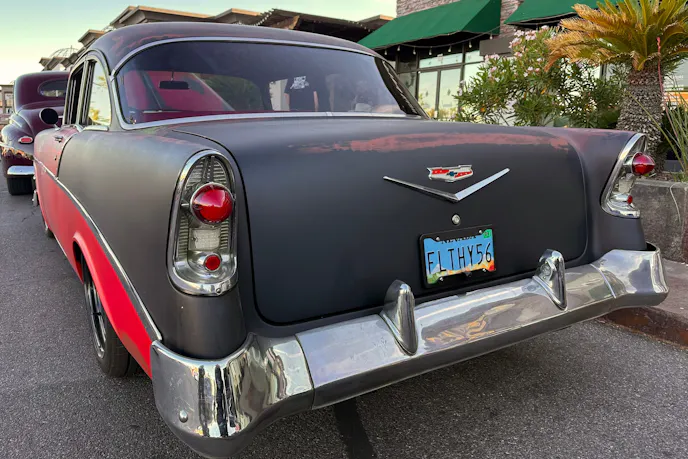
“I sanded it down and then I put the black on and went from there,” described Mike. “It took about 45 minutes — that was it.”
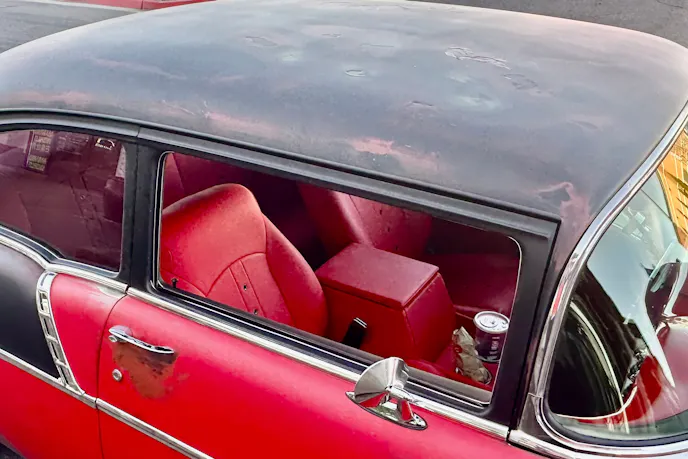
The vision took shape, imagining decades of wear across the 210’s 70 years of life. For the hardtop, he simply carried on with what the desert sun had already started. It was patina preservation at its finest.
“I just left all the stuff that was there from it being out in Apple Valley,” Mike added. ”I wanted it to be part of the look.”
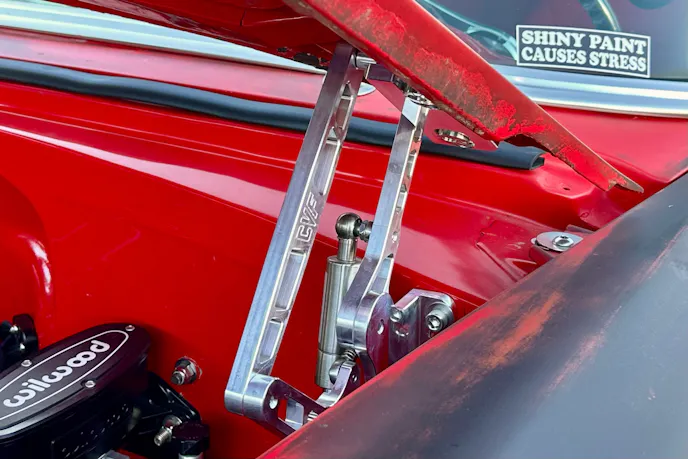
The “Shiny Paint Causes Stress” sticker tells it all. Dings, dirt or drive-grime don’t matter. The user-friendly daily goes from road-ready to show-ready in a blink.
“It just wipes off — it’s easy,” said Mike. ”It doesn’t streak. It doesn’t do anything. It’s great.”
’56 Now Cruises With Cruze Seats
Inside, Mike followed the same stress-free approach. He opted for a peaceful, easy interior using vinyl for price, practicality, and upkeep.
“We had his idea instead of just painting it,” he recalled. “We looked for the right material, and it just came out. It’s the highest vinyl you can buy.”
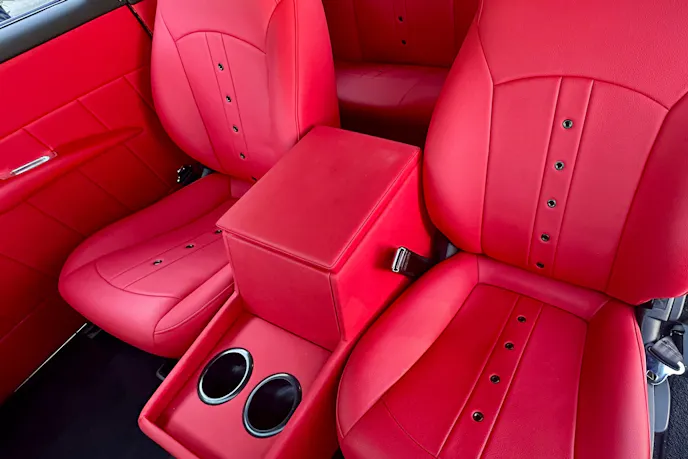
The seats came from a donor 2011 Chevy Cruze. The rails were reworked and the result is an old school Chevy with a telescoping, reclining modern seat. They’re comfy without an electric install hassle.
“It’s all manual and what’s beautiful about the seats is that they come with this flat rail with a stud,” Mike explained. “You saw it off, grind it off and then I made my own brackets to go into the factory holes.”
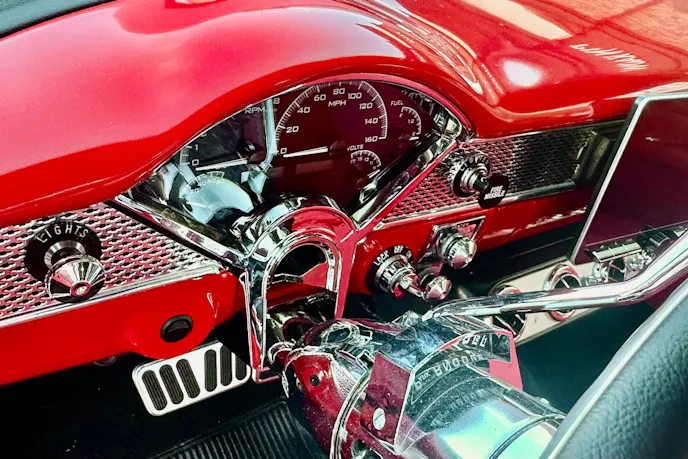
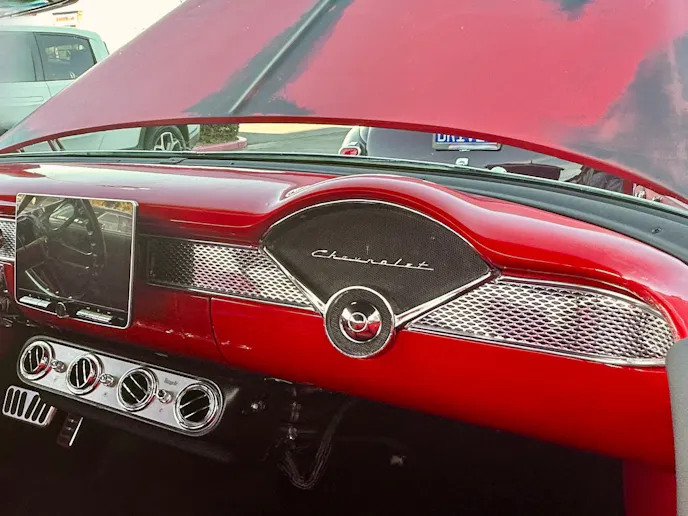
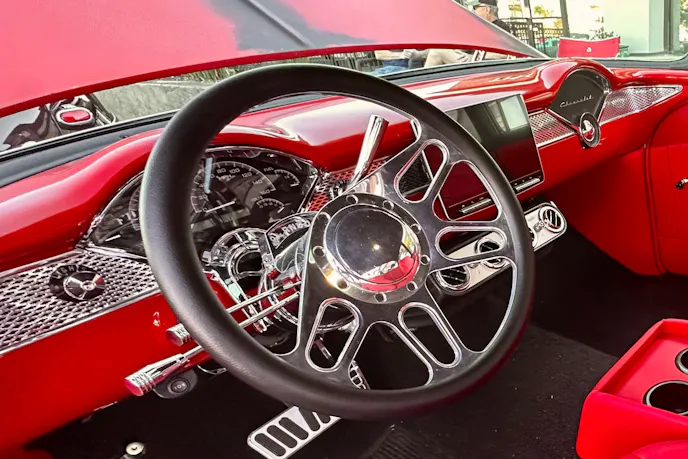
Like the engine bay, Mike went clean and tight on the tech, upgrading to Dakota Digital gauges and keeping the audio system out of sight. From heads to tails, American Autowire went all the way through.
“The head unit is Bluetooth, wireless Apple play or CarPlay,” he said. “The speakers are all hidden. They are mounted behind the interior panels. It’s the same in the back. They’re under the vinyl interior — under the perforations, so you don’t see them.”
The Most Fun You Can Have (In A Car) With Your Pants On
For a guy with many builds under his belt, this 1956 Chevy 210 earns the distinction of the most fun car Mike has ever driven. Whether he’s dailying it with a quick run to the store or roadtrippin’ out to Arizona for Good Guys in Scottsdale, his Chevy tops the list.
This ‘56 was once a forgotten shell. In Mike’s hands, the abandoned piece of Americana was given new life. Injected with nearly 500 wheel horsepower, modern underpinnings and a no-worries finish, the Chevy 210 is doing exactly what it was built to do: hammer down — get driven. And that is what makes this Chevy the funnest car Mike has ever built.
You might also like
Introducing Project F-Zilla: Old Work Truck Gets New Lease on Life
Project F-Zilla will receive all kinds of upgrades that will transform its capabilities, but its looks (and patina) will remain timeless