
The 1962 Chevrolet lineup offered three full-size, all of which were affordable for the average working American. At the top sat the Impala. It was introduced in 1958 and a top-of-the-line, semi-sporty offering. At the bottom was the Biscayne, named after that famous bay in Florida. You got one less taillight than the Impala and a rubber floor mat instead of carpeting. Between the two was the Bel Air — not to be confused with the toney town in California. It was like a Biscayne, except you got foam-padded front and rear seats and (hold on) carpeting.

Those were wild days indeed. A 1962 Bel Air two-door sedan like our feature car ran you $2,456 bucks, or $2,563 with a two-barrel-equipped, 170 gross horsepower, 283 V8. These may not have been at the top of everyone’s wish list back then, Chevy sold tons of them. And drag racers really loved them for their light weight and handsome good looks. Stuff a 409 in one and you really had something.

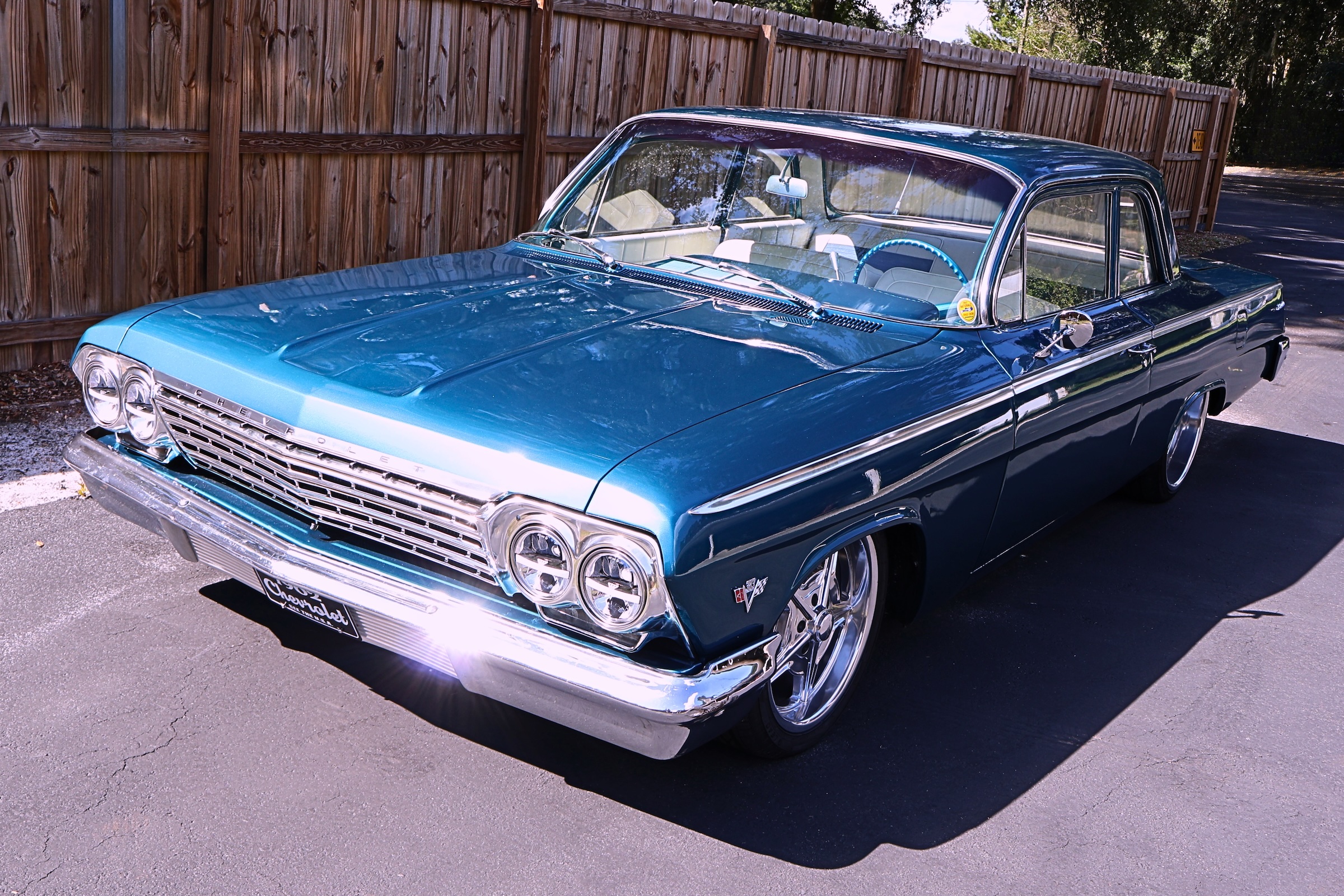
Randy Harrison of Lakeland, Florida, owns this spectacular ’62 Bel Air. It’s a long way from bargain-bin transportation, which is how it started life. Under the hood is a fully built 383, the car rides on air suspension and rolls on sexy Billet Specialties wheels.

The paint is simply gorgeous and the metallic brings out the best from the body lines. The owner added LED headlights for improved night illumination. The bar across the middle of them acts as daytime running lights.
Get Me The Engine Room
When Randy bought the car, much of the heavy lifting had been done. The Box Performance 383 was fitted with the top-shelf parts, including PBM Strike Force 23 degree aluminum cylinder heads (200 cc chambers/2.20/1.60 valves, and an Erson dual pattern hydraulic camshaft (286/298 duration, with .548inch lift and a 112 LSA.

Up top sits a Professional Products Crosswind aluminum intake, which holds a Holley Sniper EFI throttle body. Inside, a SCAT cast lightweight crank swings hypereutectic pistons on its I-beam rods. Compression is a 93-octane friendly 10.0:1. A Melling high-pressure oil pump ensures the 383 gets a steady supply of slippery stuff. It makes an even 500 horsepower.

A Champion radiator keeps it cool in the Florida sun and a CVF Racing serpentine setup adds another touch of modernity. Backing the 383 is a column-shifted Turbo 350 automatic with a 3,000-stall Hughes converter. The column shifter relies on Lokar linkage to find the right gear.

First Class Accommodations
The interior in Randy’s Bel Air is a far cry from where it started. It has custom blue and white stitched bench seats and door panels. The cluster retains its OE appearance to a degree, but it is actually fitted with high-tech Dakota Digital RTX gauges.
Chevy sold tons of Bel Airs. And drag racers really loved them for their light weight and handsome good looks. Stuff a 409 in one and you really had something.


Under the instrument panel are the controls for the Air Ride suspension. He plans on installing Vintage Air climate control in the near future to combat the heat in his native Florida. Randy added a trick ididit tilt steering column and is looking for a stock appearing wheel to replace the factory piece, which is simply huge.


Thanks to the air suspension, the Bel Air just glides down the road. Adding a modern touch are the wheels, 20s in the back and 18s up front. Tires are Leao Lion Sport 255/35R20s rear and 245/40R18s up front.


While Randy’s Bel Air is no longer the plain, inexpensive ride it was designed to be by Chevrolet, it brings you back to a time when General Motors designed beautiful, full-size rides that were affordable and could seat a family of six — without breaking the bank.

You might also like
Segerstrom Shelby Event Center Displays Rare GT500 Cars In Vegas
The Segerstrom Shelby Event Center loaned two rare GT500 drop tops to Las Vegas. Both big-block cars stay on display through December.