
Is Ford on the right track with the new Mustang Dark Horse SC or is it fiddling while Dearborn burns. Never in the car’s 62 year history has the Mustang offered more performance, sales are miserable overall. Ford used to build more Mustangs in a month than it does now in a year. So, what’s the problem?
Is it the car itself? Has the market shifted so drastically away from two-door sports coupes that the Mustang is almost irrelevant? Is it too big? Too unattractive? Or is it perfect for the market in which it now competes?

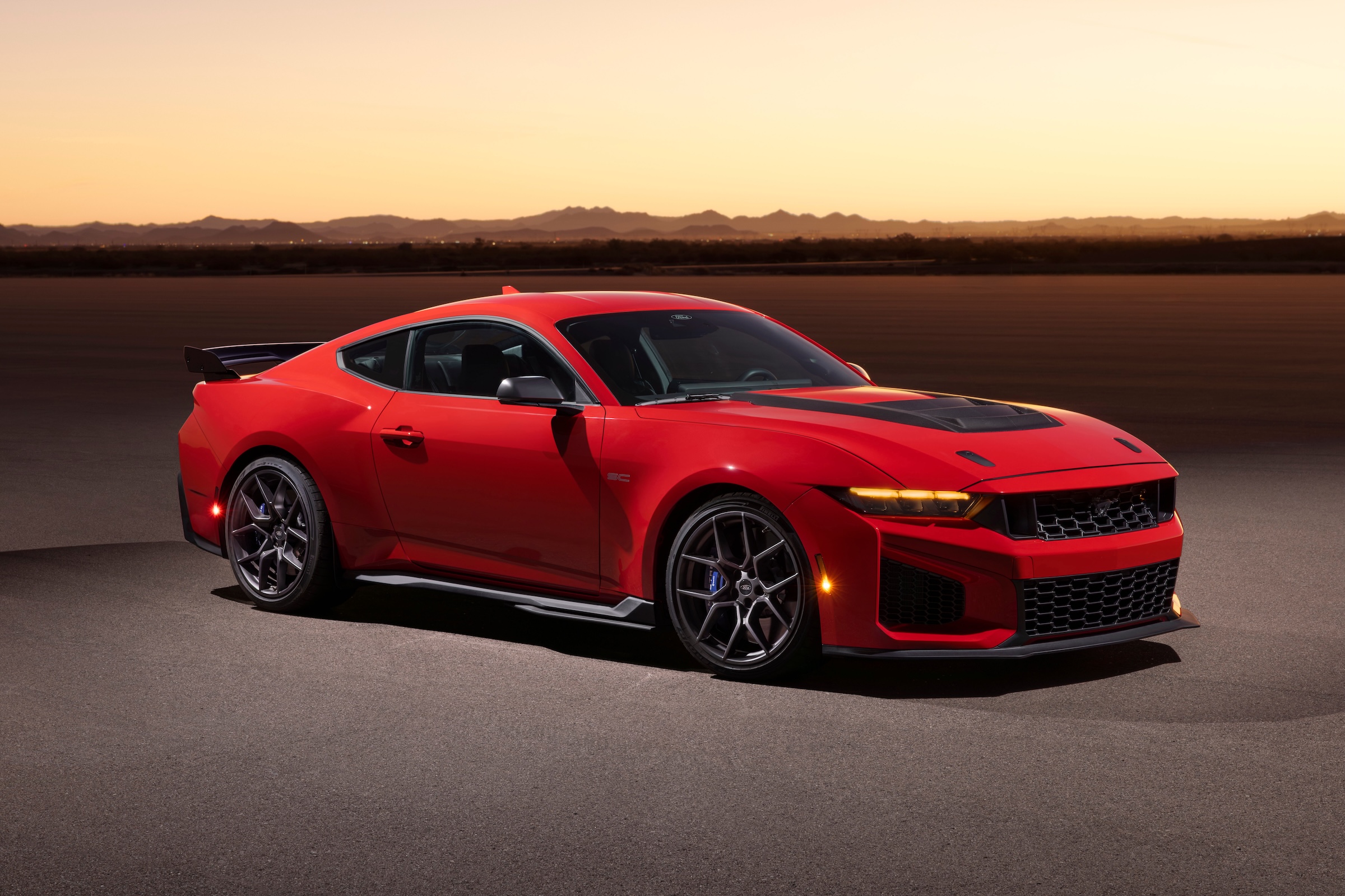
Ford recently added a new horse in the ponycar barn, the Mustang Dark Horse SC. The SC part stands for supercharged, and according to Ford, it’s the most advanced, powerful, and track-capable Dark Horse in the stable. Of course, it is only the second Dark Horse, but whatever.

The car was developed in Dearborn, but wrung out on such fabled tracks as Sebring International Raceway and Virginia International Raceway, where it was tested against the Mustang GTD and Mustang GT3 race car. As hardcore enthusiasts, we eat this stuff up. But is that enough for the average consumer? Too much?

“In my 30 years at Ford, I’ve worked on everything from powertrains to plant management, but the Mustang Dark Horse SC was developed by engineers who live their lives at racing circuits, and that track-first mentality is woven into every bolt and calibration of this car,” wrote Arie Groeneveld, the Mustang Dark Horse SC Chief Program Engineer, on Ford’s media site upon the car’s introduction. “To engineer the most advanced, powerful, and track-capable Mustang Dark Horse in the stable, we didn’t work in a vacuum. We took the Dark Horse SC to Sebring and Virginia International Raceway to test alongside the Mustang GTD supercar and the Mustang GT3 race car. This collaboration bore immediate fruit.”
Horsepower for the blown Predator engine has not been announced as it is still being calibrated for final production, but we think it will be in excess of 815. This is more than the previous Shelby GT500 had (760). No engine photos of the SC’s Predator V8 are available. Funny thing is the Mustang GTD is rated at 810 hp and it is over $300,000. Imagine being involved in that conversation at Ford.
By working with the GTD team, we were able to adopt Brembo carbon-ceramic brakes and Michelin Pilot Sport Cup2 R tires for the Mustang Dark Horse SC Track Pack. — Arie Groeneveld

Perhaps some history is in order here. In 2000, Ford sold 215,383 Mustangs. They came in three basic varieties: V6 base model, V8 GT, and the limited-production (300) Cobra R, with 385 horsepower. Then, as now, you could have them in either coupe or convertible form (except the R). This was the SN95 (or Fox-4, whichever you prefer), a car that enthusiasts today are lukewarm about.
Has the market for pony cars shifted so drastically that selling 45,000 cars in a year is cause for celebration at Ford? I think there are a few reasons for the sales slump.
- Since its introduction, the Mustang was wildly popular with all demographics — women, men, young and old alike. Today, women are more apt to purchase crossovers and SUVs, even for their first car. Yes, they opt for Mom-mobiles instead of something sporty, even if they are not moms. Old people (that is you, boomer, and me too) are either hung up on cars from their youth or want (wait for it) crossovers and SUVs. If they do want something with two doors, it is more likely to come from BMW or Audi.
- Young men who want these cars are punished with insurance rates that can be cataclysmic, and often price them out of the market (even for used cars).
- The new Mustang is simply far too big and heavy. It is larger in many areas than the much-maligned ’71-73 cars. It needs to be downsized by about 20 percent.
- The Mustang GT with a premium package is now a $60,000 car, almost $10,000 more than the average price of a new car. Yes, the base Ecoboost-powered Mustang will outperform virtually any big-block Mustang from the sixties for less than a new GT, but most customers would rather eat worms than drive a non-V8 Mustang. (Dodge is learning the hard way that people who were weaned on HEMIs won’t buy an inline six-powered Charger regardless of how powerful it is or how many turbos it has, let alone electric motors.)
- Ford continually calls the Mustang a muscle car, which drives away those customers who simply want a nice personal sporty car.
Perhaps Ford is correct. It sells all its Dark Horses (and Shelbys before that) at a huge premium, generating massive profits. Why try to build an entry-level car? If production and plant capacity jive with the business plan, the Mustang will continue to soldier on. Maybe the Mustang is no longer mass market vehicles and should be treated like specialty cars that compete in the market with Corvettes, entry-level Porsches, etc.

We’ll wrap this up with a quote from Groeneveld about the Dark Horse SC and wish Ford luck: “The result is a vehicle that sits in the top tier of the Mustang stable — between the Mustang Dark Horse Performance Package and the Mustang GTD. It is a high-powered Mustang that I don’t think the world saw coming, but it is exactly what happens when you let racing engineers design a road car.”
You might also like
Detroit Autorama Brings More Muscle to Motor City
The 73rd Annual Meguiar’s Detroit Autorama presented by O’Reilly Auto Parts brought a bevy of beautiful cars to downtown Detroit.