

When walking the floor at PRI 2025, you realize that the difference between a winning engine and a broken one often comes down to the smallest details. PBM understands this, which is why it introduced its new titanium valves to the market. For years, PBM has been a go-to for cylinder head components, but this move signals a serious commitment to the high-rpm racing crowd. We caught up with Jack MacInnis to get the story on why PBM decided now was the time to offer a lightweight alternative to its standard stainless lineup.
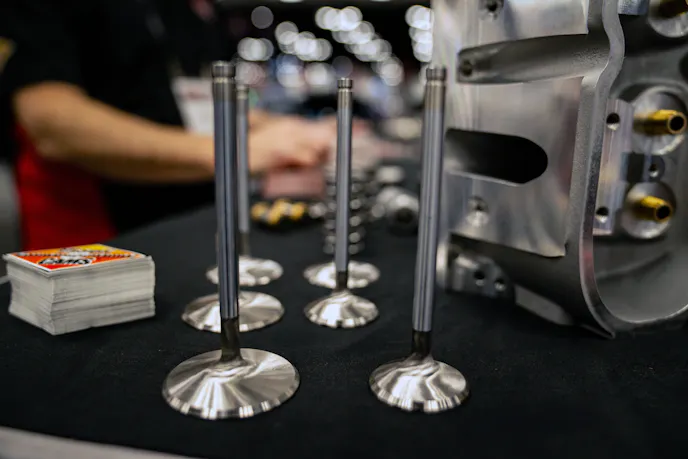
The reality of building a competition engine is that eventually, heavy parts break things. Stainless steel valves are durable, sure, but they are heavy. “They’re very light,” MacInnis told us regarding the new titanium units, “and that weight savings is critical in high-rpm engines.” When you take weight out of the valvetrain, specifically at the valve itself, you gain stability. You eliminate that terrifying moment where the valve floats, effectively disconnecting the valvetrain from the cam profile.
PBM isn’t trying to make these titanium valves a universal part for every grocery-getter. These are purpose-built for the drag strip and the racing circuit. The initial rollout focuses on fitments for PBM’s race-specific heads, covering the heavy hitters like big-block and small-block Chevy platforms and certain Ford setups. It’s a focused approach that prioritizes quality over quantity. MacInnis noted that while they are relatively new to manufacturing titanium options, the goal is to ensure perfect compatibility with their heads.
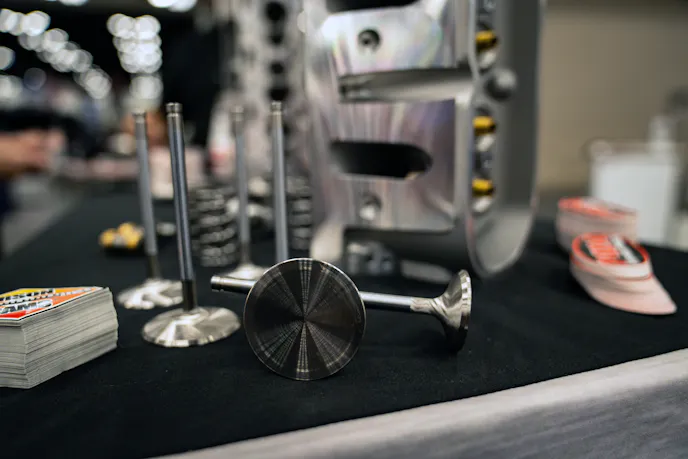
By reducing the reciprocating mass, these valves do more than just unlock rpm; they save the rest of your valvetrain from abuse. A lighter valve is easier to control, which means your valve springs last longer and your valve seats stay sealing tight. For the engine builder looking to extract every last bit of horsepower without sacrificing reliability, swapping to PBM titanium valves is the kind of upgrade that pays for itself in longevity and response. It’s just another tool in the box for racers who refuse to leave anything on the table.
You might also like
Homebuilt 1967 Cougar: The Sign Of The Cat & Sign Of The Times
The homebuilt Cougar had been a drag car and there was a gaping hole in the hood to accommodate the car’s previous tunnel ram intake.