
Most people associate big single turbos with lag. You usually have to wait for the engine to build enough rpm to overcome the inertia of a massive turbine wheel. HPT Turbochargers aimed to delete that trade-off with the release of its F5 Dual-Entry Turbos. This design took a concept often used by OEM engineers to improve efficiency and scaled it up for the 3,000-plus horsepower market. The result is a turbo that packages easily in a tight engine bay and responds with the snap of a much smaller unit.
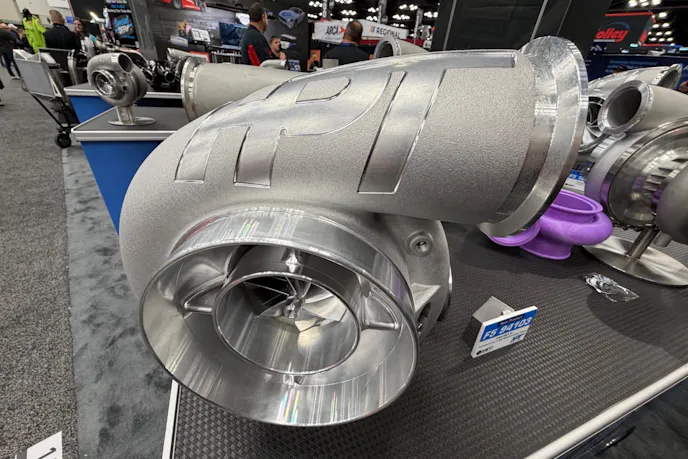
The core advantage here was how the housing managed exhaust energy. When you force two banks of a V8 into a single pipe, the exhaust pulses interfere with each other, creating turbulence and wasting energy. HPT’s dual-entry design maintained the separation of those pulses all the way to the turbine wheel. According to Harry Hruska, the owner of HPT, this resulted in the wheel getting hit with energy twice as often per rotation. This “double-hit” strategy drove the turbine harder and more consistently, allowing the turbo to transition from idle to boost much faster. It effectively mimicked the pulse utilization of a twin-turbo setup but kept the simplicity of a single power adder.
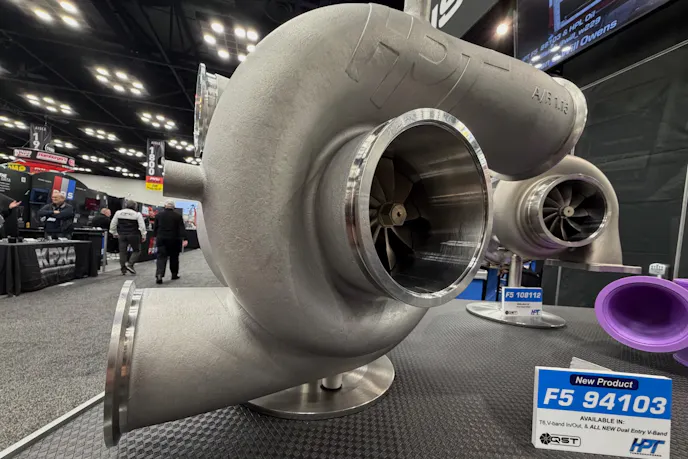
Fabricators will appreciate the V-band inlets and the 1.15 A/R housing design. Instead of fabricating a merge collector that fights for space with the radiator or water pump, you can run two clean, independent pipes directly to the turbo. It made the hot-side fabrication process faster and cleaner. The housing was also future-proofed. Hruska mentioned that while they were currently pushing 3,000 horsepower, the turbine side supported up to 4,000 horsepower. You could start with a smaller compressor for a street class and swap to a larger wheel later without redoing your exhaust work.
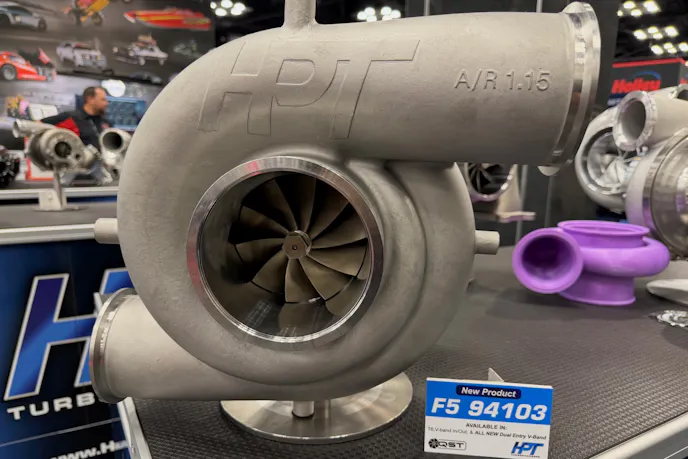
This housing was part of the broader F5 series, which included billet wheels and heavy-duty dual ball bearings designed for competition. By solving the packaging constraints of a traditional single turbo and improving the fluid dynamics of the exhaust flow, HPT created a product that made high-horsepower builds simpler to execute and more fun to drive.
You might also like
Project Mighty Mouse Gets A Howards Cams Setup Built For RPM
Here is a full breakdown of the SBC rocker arm installation on Project Mighty Mouse's 327, from pushrod measuring to setting preload.