
Progress on Project F-Zilla, our 1969 F100 with a built Godzilla plant, is really kicking into high gear. Our Art Morrison Enterprises frame is in our shop and its Ridetech coilovers are mounted — more on both of those soon. But today, it is all about prepping the cab for those nights of effortless cruising in a classic truck.

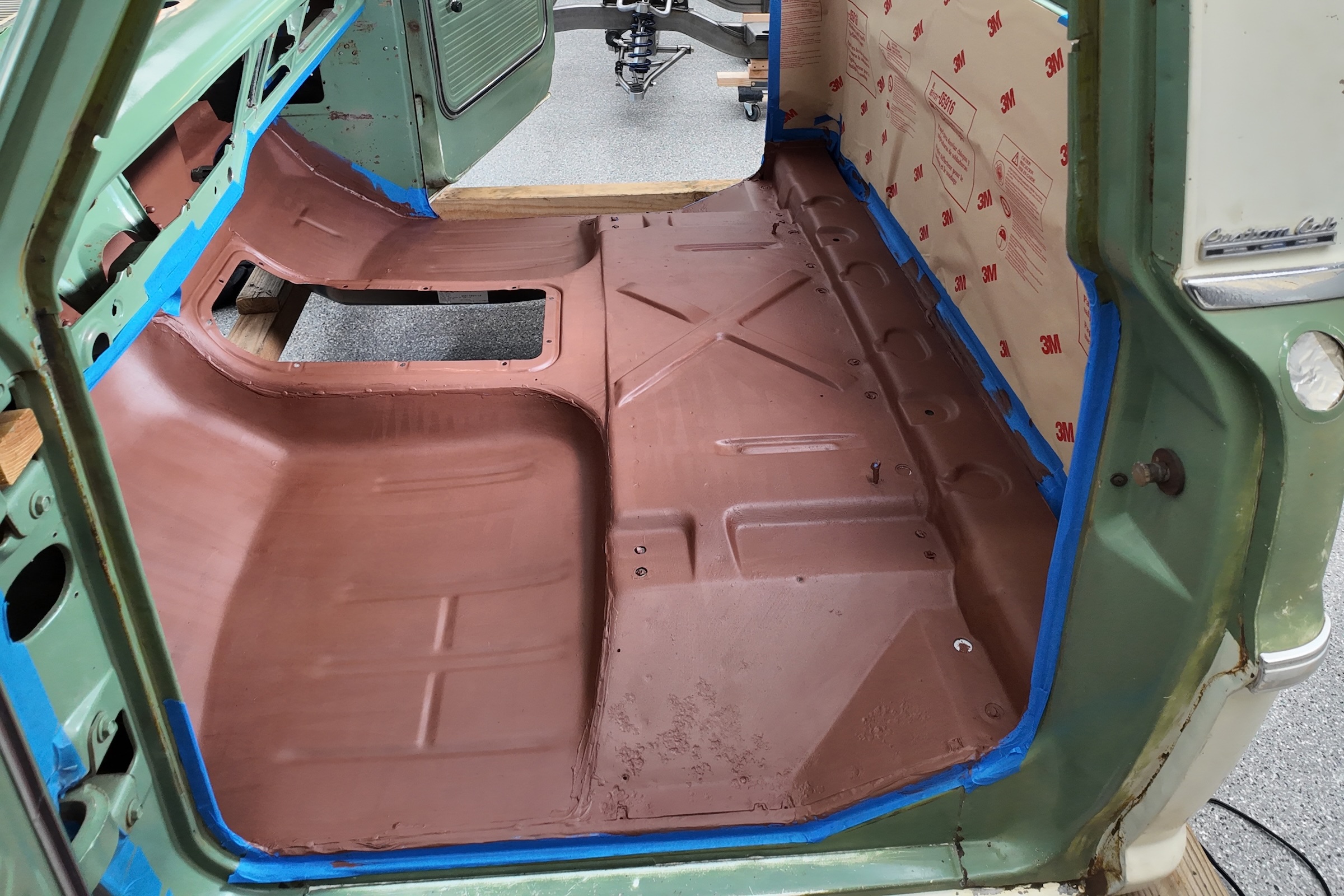
The floors on our Ford were in woefully poor condition when we started. Preston Rice, our shop manager, replaced a ton of sheetmetal with the best replacement parts from Auto Metal Direct. Now it was time to prep the new floors with a primer application and sound deadening spray.

Because we want the cockpit to retain the same level of patina as the exterior of the truck, we left the back wall, inner kick panels, and rest of the cab alone. They will remain in their original factory green paint. And while the rest of the cab will not be fully sealed, the gray flooring will be covered by DEI products.
Products: What We’re Using
The first product we used was Design Engineering Inc.’s ATAC Red Oxide Primer. ATAC Red Oxide Primer is a quart-sized, 100 percent acrylic resin, water-based latex primer that seals and primes metal for ATAC coating.

ATAC is an acronym for Advanced Thermal-Accoustic Control. The Red Oxide Primer is the ultimate first step to surface preparation, designed to prime and seal metal surfaces for long-lasting protection. It is specially formulated to create a strong foundation for ATAC coating, effectively encapsulating and preventing rust while sealing surfaces against moisture and corrosion. It can be used on any metal surface, and not only enhances adhesion but ensures a smooth, even application for a durable finish.
It is easy to use (we brushed it on) and does a myriad of essential tasks. It seals and stops the spread of rust and has excellent adhesion to most metal surfaces. It does not require a top coat, but it can be finished with most latex paints or coatings. It also offers superior waterproofing and chemical resistance.

We then sprayed on a layer of ATAC Advanced Thermal Acoustic Coating. It controls both heat and sound, and can be sprayed, brushed on, or applied with a roller. We opted to spray it on and for that we got a spray gun from DEI. The DEI spray gun has larger discharge nozzle designed for heavier coatings and thicker fluids. It provided an even application and easy control.

First Step: Prep & Cleaning
The first step, naturally, is to prepare the floor for proper adhesion of the DEI products. Rice used a degreaser spray and Scotchbrite pads to clean surface rust, scaling, oil, grease, and other contaminants. Afterward, Preston Rice gave the area a clean water rinse and wiped the water away.


The Red oxide primer sealant was applied using a brush and roll-on method rather than the spray gun. Why? Simply, it is easier to get into nooks, crannies, and under the dash up to the belt line.

Once the primer dried, Preston brought in the DEI spray gun. This made quick work of applying the Advanced Thermal Acoustic Coating. DEI calls this product a “revolution in automotive interior comfort.” It was developed to be a one-step solution to control both heat and sound.


“ATAC coating is designed to transform the interior of your vehicle into an oasis of comfort. Say goodbye to the discomfort of excessive heat and annoying noise, and say hello to a serene, cool, and quiet ride,” says DEI.
It reflects heat up to 375 degrees and because it’s water based, it’s easy to clean up. One gallon covers approximately 75 square feet.


We also went to DEI for a proper supply of its Boom Mat, which will be installed at a later date. Boom Mat Vibration Damping Material is a premium quality damping material providing extreme noise damping for the most demanding applications, including stereo competition. Boom Mat features an easy peel plastic release liner (not a paper backing that tears), which helps quicken installation.

Next up, we’re going to turn our attention to the chassis. Stay tuned.
You might also like
1,511-HP Street Machine: John Warren’s Nuclear ’72 Chevy Nova
It's still the same Chevy Nova that Warren drove to school, only it's packing enough power to run with the quickest cars in the country.