
At Street Muscle Mag we’ve covered Ford and Mopar builds from Prestige Motorsports, so we figured it was time to get on board with some GM love, this time its Prestige’s boost-ready LS engines. Prestige designs, machines and assembles a wide range of high-quality LS powerplants for street and track; its engines perform well, look great, and most importantly, are Swiss-watch reliable.
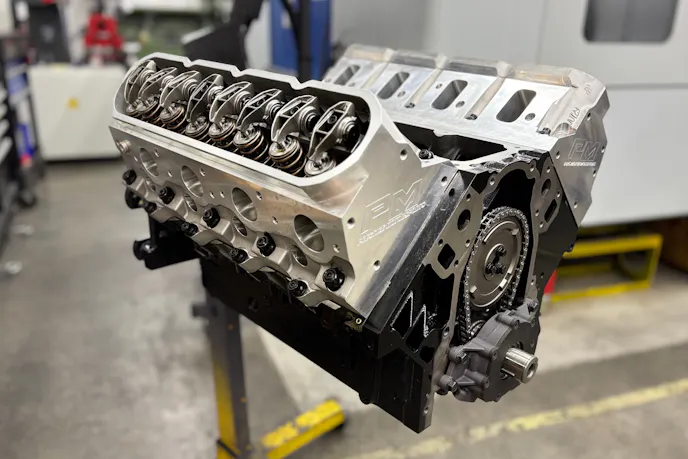
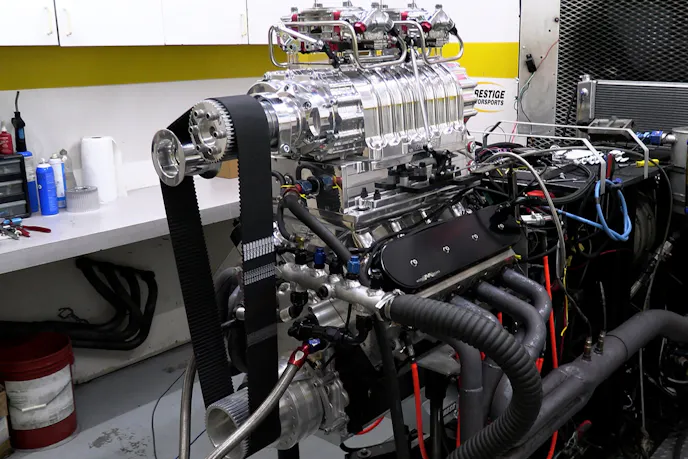
LS swaps (and builds) remain among the most common with enthusiasts, so boost-ready LS engines make a ton of sense. We dug deep into Prestige Motorsports’ offerings, specifically the 408 and 427s engines. The 408 is a 1,000-horsepower pump-gas beast and the 427 takes output to 1,200 ponies — still on pump gasoline.
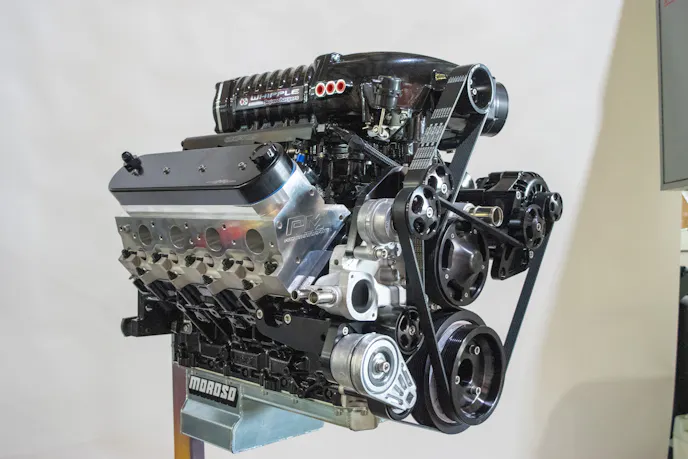
Prestige can build you just about anything, but in this article, we’re going to look at boost-ready LS options. Power-adder-equipped engines can deliver double or triple the output of a naturally aspirated engine, making them a great choice for many builds. Superchargers are mechanically driven off the crankshaft, so response is instant. Similarly, turbocharged engines have endless horsepower potential. Turbos use exhaust gases to generate boost, reducing parasitic loss, but often the inlet and exhaust tubing can be more complicated than with a blower.
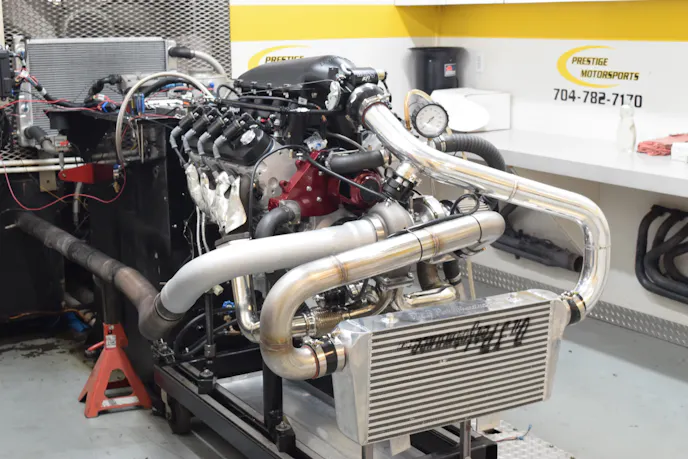
Prestige also offers nitrous packages, should you want to use the juice for extra power. Nitrous is initially the most cost-effective and straightforward power adder, delivering a sudden surge of power with both carbureted and EFI setups. Nitrous can be hard on internals so Prestige takes great care to install severe-duty components with ring-lands and cams designed for the job.
We offer two stages, along with custom engines,” said Doug Aitken, president of Prestige Motorsports. “And our engines are built to meet-or-exceed the wants and needs of our customers.”
Everything starts with a good foundation, such as a Dart LS Next and the Pro blocks, or Concept Performance and several others, but it definitely starts with an aftermarket foundation.
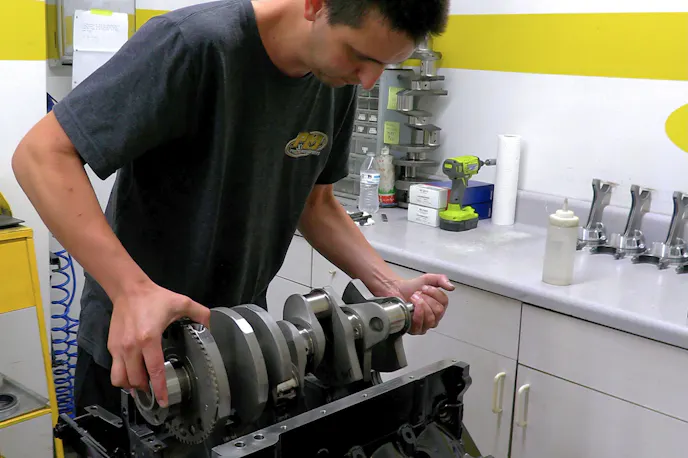
”If it’s iron, we use primarily Dart and there’s a couple different manufacturers in the aluminum world, like Concept Performance and the LSR block is a good piece and Noonan billet, we’ll use that, too. The customer usually dictates that part of the build,” said Aitken. “They’re like, I want a Noonan billet, you know, or if’s somewhat price-oriented, like the SHP from Dart, we’ll use that to keep some of the overall costs down. An SHP these days is probably $3,000 versus anything aluminum. The LSRs are going to be between $6,000-7,000, and billet stuff’s going to be $8,000 to $10,000. So, you know, it drastically increases.”
Thankfully, the LS is a capable platform, so the sky truly is the limit in terms of horsepower. Nevertheless, the Prestige packages benefit customers because the team has done the groundwork to build powerful, yet reliable combinations.
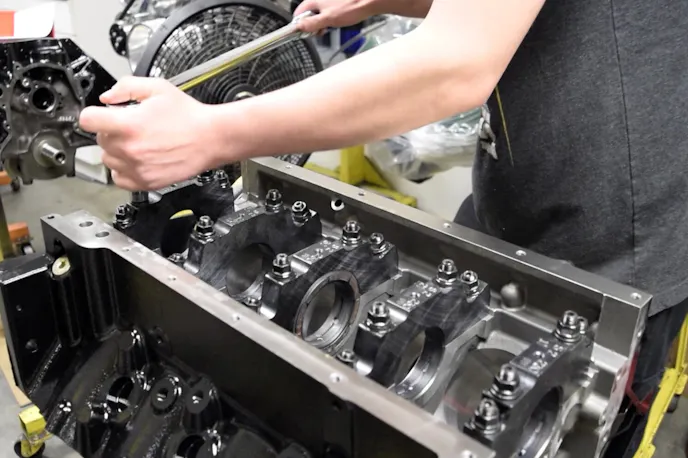
“A lot of guys today just want 1,000-horsepower for a resto mod,” Aitken stated. “In a case like that, iron is fine. If they want aluminum, that’s fine, too. If it’s for drag racing, the argument really is that a billet block could be repaired much easier. If you kick a rod out and you break a pan rail off, you can weld it back up. You can slide a sleeve out and re-sleeve it. On something that’s going to get abused, the billet block will probably save you money in the long run because you can repair it.”
It’s worth noting, unless otherwise stated by the customer, the PM 408 uses a factory, 6.0 LS iron block with a 4-inch stroke. With the 427 the stroke is the same, but with a larger bore. The large bore helps unshroud the valves and that makes the cylinder head breathe a little bit better. But more importantly, you’ve got that aftermarket block foundation and a 4.150-inch or larger bore.
Internal Components
While the block is the foundation, a quality rotating assembly is also a must.
“We typically install a 4340 forged crank with H-beam or I-beam rods. Boostline is a good rod for your average build, up to 1,500 horsepower, but Eagle, SCAT, LTC, Manley, and Molar make good stuff,” said Aitken. “They’re all in the same category, even Callies Comp Star. The step up from that would be getting into billets, like a Callies or Sonny Bryant. Those parts are good for 2,000 or 3,000 horsepower. It’s not necessary in a 1,000-horsepower engine, but some people demand it. They feel a sense of comfort and insurance policy, if you will.”
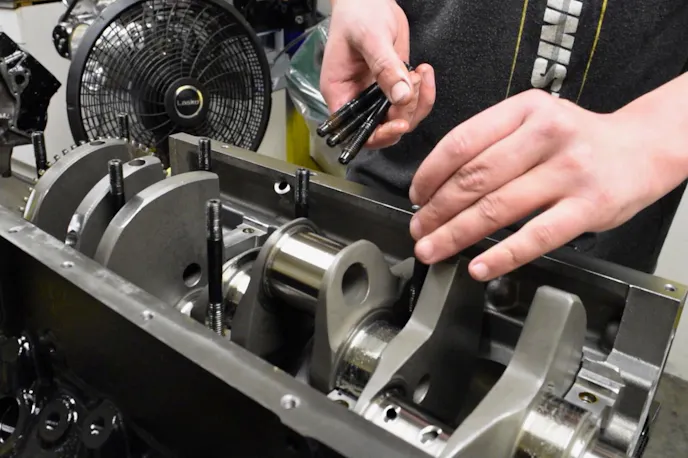
One area where boosted engines require a change as compared to NA engines is in the pistons. This change often comes in a more robust design and you’ll see the ring lands moved away (down) from the crown.
“In pistons we pay close attention to ring location and compression height,” said Aitken. ”You do see guys build big-stroke motors and it’s kind of unnecessary because in our opinion, just shove more boost in there to make more power. I mean, increasing the stroke is good up until a certain point. Once you start losing compression height in the piston, that becomes the weak link.
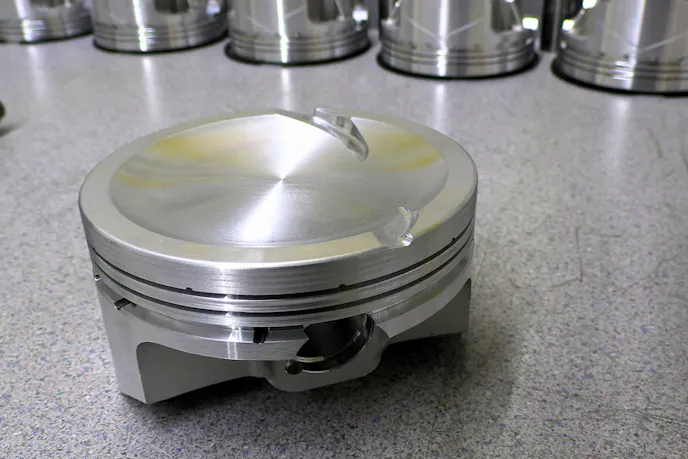
”So, we try to keep as much compression height in that piston as possible, like a 1.250-inch compression height would be good. And typically, in our boosted stuff do gas porting. For people who aren’t familiar, if it’s a drag motor, we’ll do a vertical gas port, so [the piston] is drilled from the top down, and combustion gas goes behind the ring to enhance ring seal. But that does introduce carbon deposits and eventually they’ll plug up. On a race motor, it’s okay because you don’t have a lot of idle time and/or part-throttle cruising. If it’s a street car, we’ll do a lateral gas port where it’s drilled above the ring, but coming in laterally.”
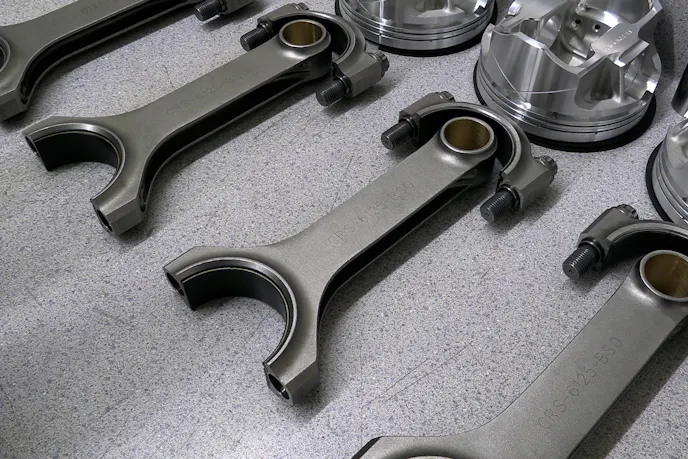
Does Prestige have a piston supplier preference?
“RaceTec is our primary supplier, but like anything, we use other manufacturers like JE and Diamond. JE has the ability to rapidly deploy a custom piston for us, not only design it, but get it in our hands. It is far more rapid than some of the other manufacturers. Ultimately, what’s important is good quality and quality control. Yesterday might not be today, and every year and every day, we monitor our quality and that of the parts we use. We also add heavy wall pins, and DLC coating options for the pins so they don’t gall when they’re under that kind of load. There’s quite a bit that goes into the bottom end to ensure reliability,” Doug stated.
Aitken is a believer in not over complicating the builds, so he often selects a hydraulic roller for street engines and a solid roller for race engines.
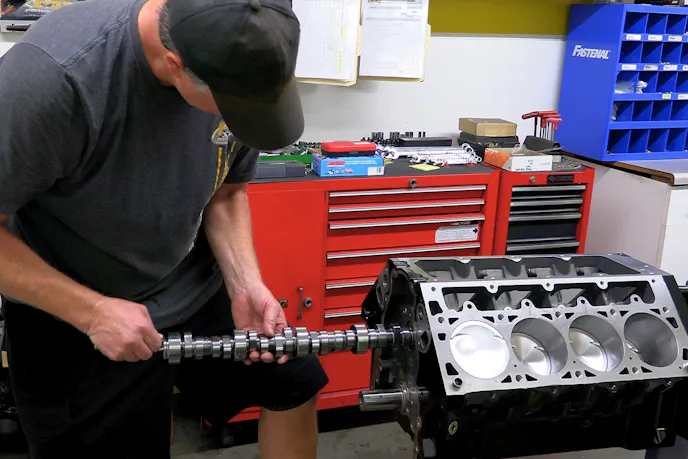
“Camshaft wise, if it is a street car, we like a hydraulic roller because they don’t need aggressive profiles to make big power with less maintenance. I mean, you can make 1,000 horsepower and drive it across the world these days,” he stated. “They just don’t need aggressive profiles and big springs to control all that because you got boost. In a drag race application, it’s going to be a solid roller and certainly we’ll get more aggressive.
“Typically, we’ll widen the lobe separation a little bit, but we don’t need a boost-specific camshaft. They don’t vary a whole lot from a decent NA camshaft. Typically, we run a 107 or 108 lobe separation angle when we get into boosted stuff. But you might be at 112 or 114 because you can trap more boost in. When you have that overlap period, you’re just losing cylinder pressure or boost out of the exhaust.”
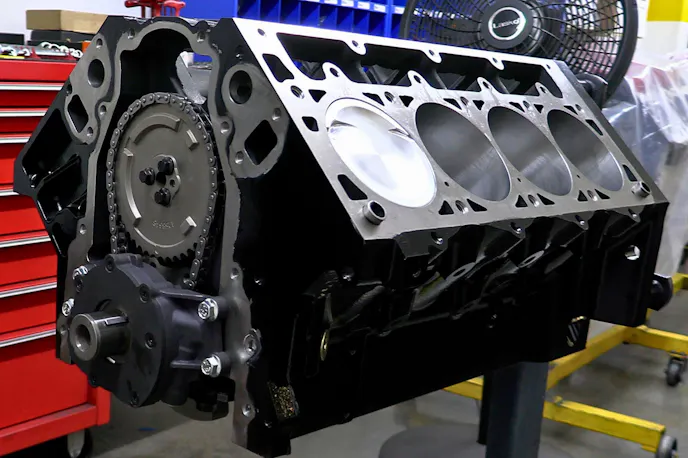
There are small differences between a blower and nitrous or turbo build, according to Aitken.
“Nitrous is going to be a little bit different,” he said. “But as far as doing a screw blower versus, say, a side-slinger, like a Procharger, or like a Whipple, it’s relatively all the same. It doesn’t really matter what you’re running. We don’t change the build based on the blower type. Now, with a turbo, the camshaft’s a little different because we’re using the exhaust, but really the heat energy from the exhaust, to spool the turbo. So, the camshaft is different in a turbo car.”
If you’re wondering, the Prestige Motors boost-ready LS engines come in at roughly 9.5:1 compression, which enables them to run on pump gasoline. Of course, this can be customized to the owner’s needs, but 9.5 is the sweet spot for most combinations.
Head of the Class
Induction is critical in any engine, including boosted powerplants. The aftermarket is flooded with options, but PE has its favorites.
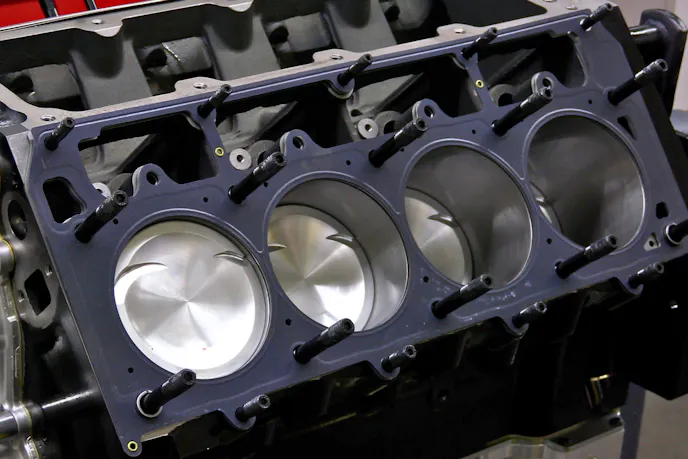
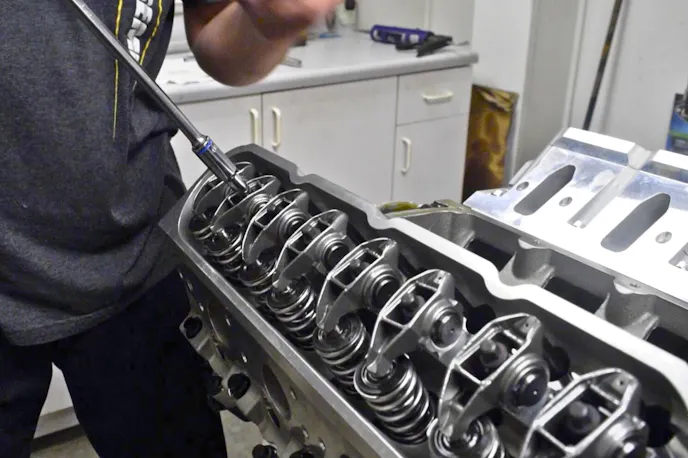
“You may be surprised to learn it doesn’t take a crazy cylinder head to make 1,000 horsepower [with an LS],” Aitken stated. “So, 90 percent of what we do is rectangular port LS3- or LS7-style aftermarket heads. We have our own casting, but we use Brodix, too. What’s most common on the market today is a LS3 bolt pattern with an LS7 valve angle. It’s a hybrid of an LS3 head. We like the 11-degree valve angle, and that’s typical with builders,” he said.
But Aitken added, “If a customer’s flavor is Frankenstein, or Mast, or LME, or whatever that might be, we’ll use them. We do have our own 285-series head as well. We call them our PM5 heads. What’s important is using good valves and good valvetrain components. With boost we always put in in Inconel exhaust valves and severe-duty, stainless intake valves. With 7,000 rpm or less, we’ll run the stainless and Inconel. If it’sgoing to be over 7,000, then it’s all titanium,” he added.
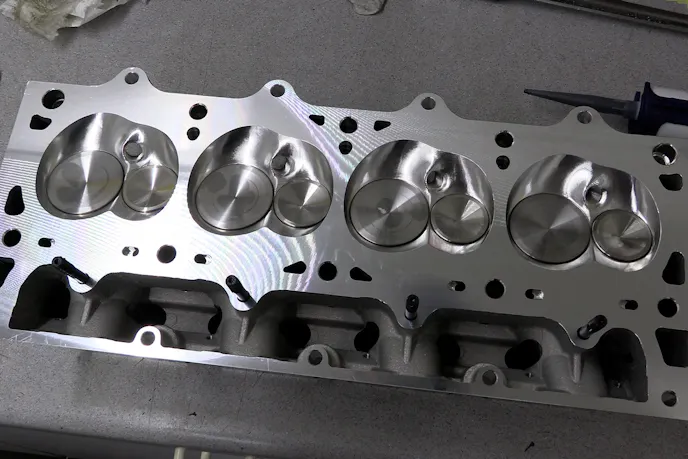
The valve game can be tricky as there is a wide range of quality and price points.
“When you get more elite, you go from a $2,000 set of 16 to a $4,000 or $5,000 set. The benefit is that as you get a better valve, the roughness on the stem is almost zero. I mean, it’s a mirror. When you get a cheaper valve the surface finish is not as good, and it’s like you’re running sandpaper up and down the valve guides in a sense. That’s not real desirable. I guess it might be fair to point out we do 8 mm stems; the intake valves are 2.165-inches, and the exhaust is a 1.60. Obviously, a quality timing set is important, and each PM engine is finished with a quality oil pan. A good pan is very important.”
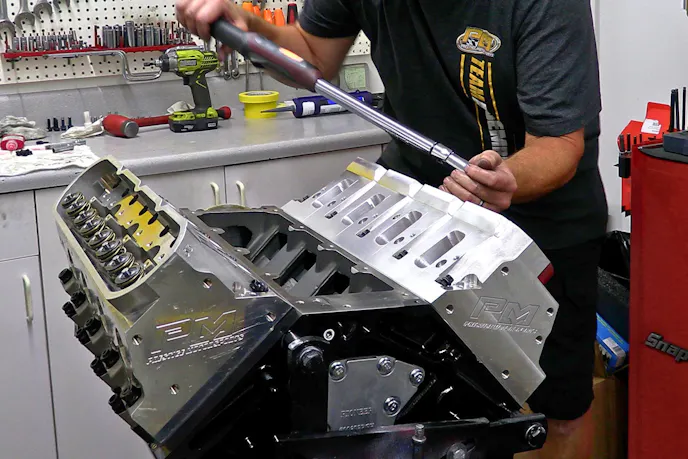
Aitken added that Prestige puts a heavy emphasis on oil control.
“Even our Cruiser Series engines, which are for a guy that’s just putting it in his old truck, get aftermarket pans.” And there’s different levels of those pans. “You’ve got to suit it to the car, but if it’s drag race, it’s built slightly different than what would be a road course pan. A resto mod pan will generally differ from a pan for autocrossing, they are application specific,” Aitken’s said. “It’s always important to focus on good oil control. Moroso does a great job. They also do a very good job of having an offering that suits a tighter budget in steel or aluminum. Moroso is kind of our go-to partner on pans for wet sump. For dry sump, they have a great offering, too, as does Daily Engineering.
“The one thing we like about Daily stuff is that the pump basically bolts directly to the oil pan. It’s all billet, so there’s no suction line(s). And they’ll do something custom if need be.”
Heavy Breathing
As you may have guessed, intakes are often owner’s choice because there are so many variations. Prestige keeps an open mind on the induction.
“If it’s a Whipple or a Roots, the intake is going to come with the supercharger,” he said. “If they’re doing a Procharger or similar, then, it can be anything the customer wants. Because we have the car shop, I take it a little further, aesthetically. We look at each build and ask, ‘Are we building something that’s going to be a usable, functional piece of art, is it going to roll across the auction block? What are we building?’ We help guide [the customer] because quite frankly, many times people don’t know what they want.”
The flexibility is one thing that helps Prestige stand out. Then there is an often ignored area.
“Another notable thing is to make sure the valve covers have adequate breathing. A lot of owners are using a traditional LS cover, and they’re not vented properly. You already have, you know, ‘X’ amount of crankcase air movement. I don’t want to call it blowby, but air below that piston. When that thing [the piston] descends, the air must go somewhere. And then you introduce boost on top of that, of which some of the air is going to get by the rings. Well, we need to evacuate it. So, I think it’s important that the valve covers can handle that. Again, it can be customer choice, or we will guide them, but they must be vented properly. Otherwise, you’re just going to be squeezing oil out of everywhere and creating leaks.”
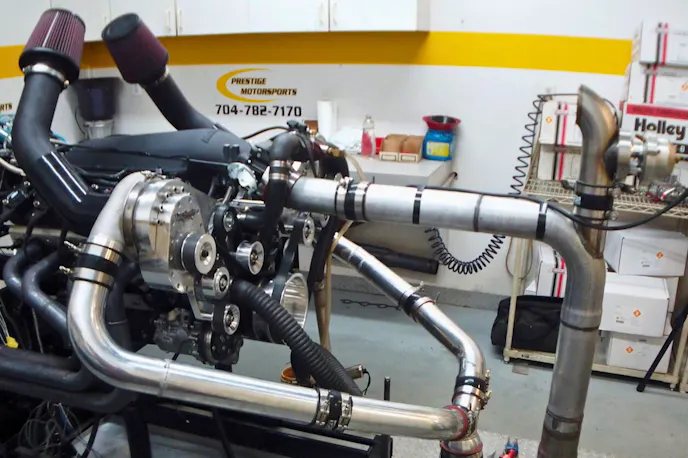
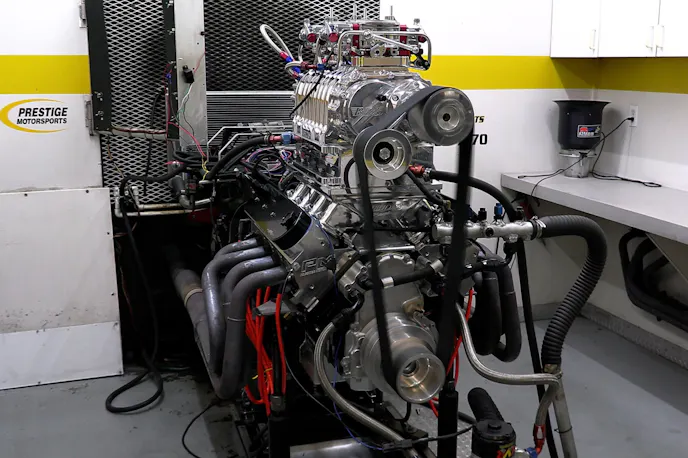
Ultimately, we all know the LS can deliver on the street and on track. The Gen 3 and Gen 4 small-blocks offer big power potential in a compact size that can fit in just about any car on the planet. Prestige Motors has taken done the development and is ready to deliver your boost-ready engine so you can get going right away. It offers everything available from a short-block to a a long-block, turn-key carbureted or EFI, and drop-in-ready with your pulley kit of choice. Turn-Key and Drop-In-Ready engine packages are dyno tested and every package is personalized-for-you and tailored to your ride.
You might also like
Pure Pontiac Power Pushes ’65 GTO To Streetable 8-Second ETs
Pure Pontiac People, we have found your hero. This GTO run a best of 8.28 at 174 mph, but it does it with real Poncho power and a stick.