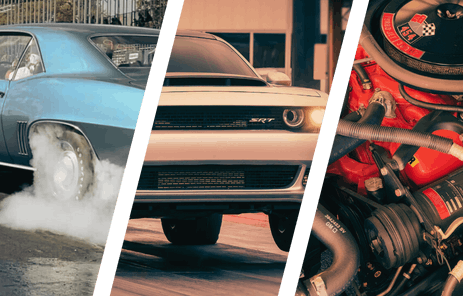
Bent axles and broken axle flanges are more than an inconvenience. They signal that a conventional flanged axle rearend has reached its limit. Strange Engineering built the Pro Touring Floater Kit to solve that problem. The kit moves the load-bearing responsibility off the axle and onto the wheel hubs instead.
How the Pro Touring Floater Kit Works
A conventional rearend asks the axle to do two jobs. It has to transmit torque and support the vehicle’s weight at the same time. The Pro Touring Floater Kit (F5010) changes that equation. Redistributing weight to the wheel hubs lets the kit resist cornering, braking, and acceleration loads that would otherwise hit the splined floater axle. The axle then only has to transmit torque from the center section to the wheel hub. That single change multiplies the axle’s load capacity well beyond what a traditional flanged axle rearend can handle.
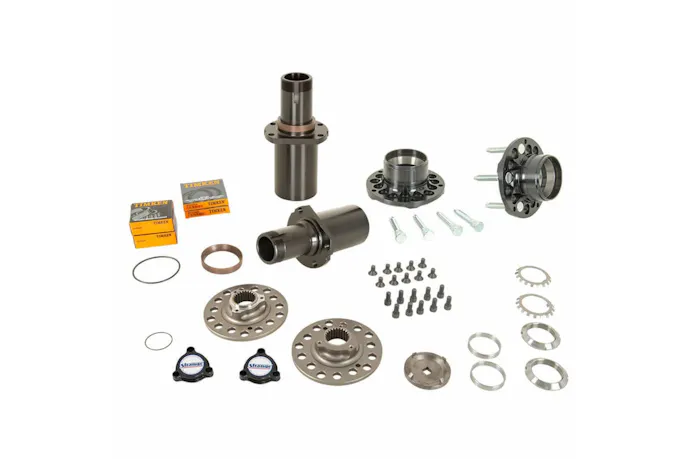
The kit’s rigid, full-floating design drives that advantage. Most factory muscle cars use a semi-floating rearend instead. A single bearing supports the axle shaft near the wheel in that setup, and the axle itself carries both torque and vehicle weight at that point. A full-floating design works differently. It uses a spindle and hub assembly to carry the weight independently of the axle. That difference explains why the failure modes that plague flanged axles become far less of a concern.
Bearing Preload and Piston Slap Control
A solid pre-load spacer, tapered Timken roller bearings, and a specially designed spindle lock nut eliminate bearing end play together. They also stop the shock of brake caliper piston slap during hard cornering. The bearing pre-load retention system relies on its own dedicated socket, built for use with a torque wrench. That socket removes the guesswork from tightening the nut correctly. Strange Engineering backs up that system with a spindle nut wrench (F5056W), giving builders the correct tool to service the kit down the road. Builders no longer have to improvise a solution. Strange also lists individual service parts for the kit, including a floater hub seal (F5056J) and a Timken tapered bearing (N1948), so builders can maintain the assembly down the road without sourcing generic replacements.
The result is uniform torque and pre-load every time. That consistency translates directly into steadier safety and stability at the track or on a canyon run. It also keeps the brake pedal firm through hard cornering. Bearing play would otherwise knock the caliper pistons back and soften the pedal, a detail that matters just as much on a road course as it does at the strip.
Chrome-Moly Construction and Wheel Fitment
Strange Engineering machines the drive plates and hubs from chrome-moly steel for a precise fit and long service life. Shifting the weight balance from the axles to the hubs adds an extra set of bearings into the equation. That extra set increases overall strength, cuts down on wheel hop, and improves traction retention by eliminating end play. A compact 3.5-inch brake clearance gap keeps the kit compatible with suspension components on most applications.
Fitment stays flexible, too. The drive plates work with multiple wheel lug patterns, including 4.5-inch, 4.75-inch, and 5-inch bolt circles. The standard press-in wheel stud size is 1/2-20, though builders needing extra strength can step up to 5/8-18 studs. Every kit includes stud sleeves, lug nuts, and washers, so builders aren’t left sourcing small hardware separately.
Brake Kit Options
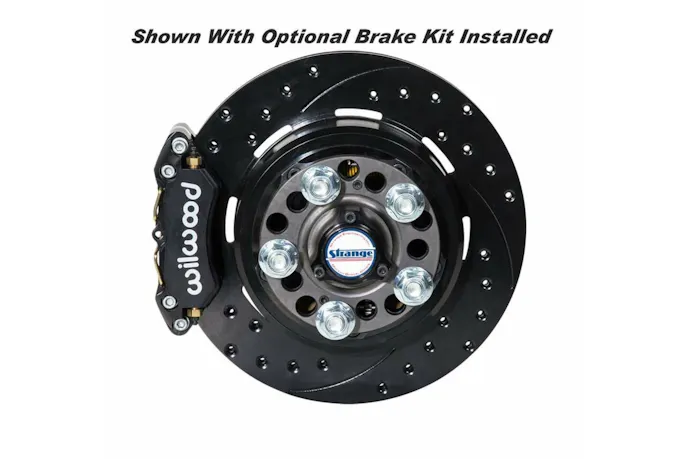
Since the kit requires a Strange/Wilwood custom Pro Touring brake kit, Strange offers several rotor and caliper combinations to match it. Options include an 11-inch rotor kit with black four-piston calipers built for 15-inch beadlock wheels (B2712WC), a 12.19-inch rotor kit with black four-piston calipers (B2711WC), that same 12.19-inch rotor paired with red four-piston calipers (B2711WCR), and 14-inch rotor kits available with either black (B2714WC) or red (B2714WCR) four-piston calipers. That range lets builders match caliper color to the rest of the build while picking the rotor size that clears their wheel and suspension package.
Axle Material and Spline Options
Strange Engineering offers the floater axles in two different material choices depending on the application. The standard Pro Race Hy-Tuf floater axle (A5100H28) uses involuted splines. Strange hobs those splines before heat treating and then thru-hardens the axle for maximum torsional strength. The drive plate end uses a 35-spline configuration with a 30-degree pressure angle. Strange taps the axle 3/8-24 to make removal easier, and a Spirolox retainer keeps the axle from shifting in use. This same axle also comes in 24-inch or shorter (A5100H24), 28 1/8-inch to 32-inch (A5100H32), and 32 1/8-inch to 36-inch (A5100H36) lengths.
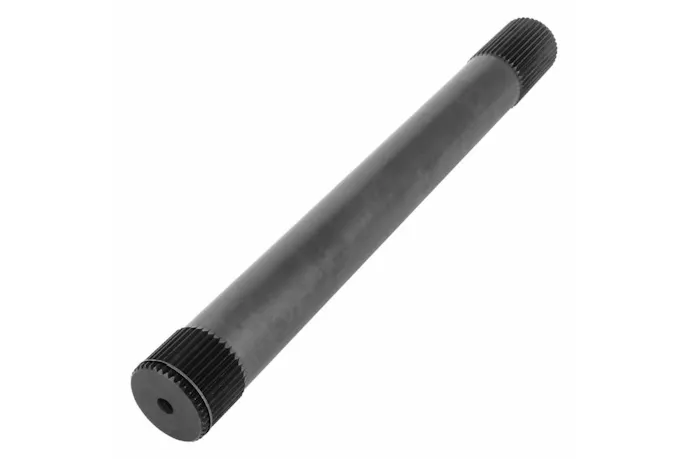
Builders who need even more strength can step up to a 300M axle option (A5200M32), used with the cambered kit. It uses a crowned 24-spline drive plate end, the same hobbed and thru-hardened construction process, and a 7/16-20 tap for removal. Strange offers this axle in 20-inch or shorter (A5200M20), 20 1/8-inch to 24-inch (A5200M24), 24 1/8-inch to 28-inch (A5200M28), and 32 1/8-inch to 36-inch (A5200M36) lengths as well. In both cases, Strange machines the inner end of the axle to suit the customer’s specific differential. That keeps the kit adaptable across a wide range of rearend housings.
Cambered Spindle and Toe Plate Configuration
Strange Engineering also offers the Pro Touring Floater Kit With Cambered Spindles & Toe Plates (F5012) beyond the standard kit. It lets builders fine-tune suspension geometry without redesigning the entire housing. This configuration simplifies housing construction, too. It allows the weld-ends to line up directly with the carrier centerline, instead of requiring the housing to already have camber and toe built in.
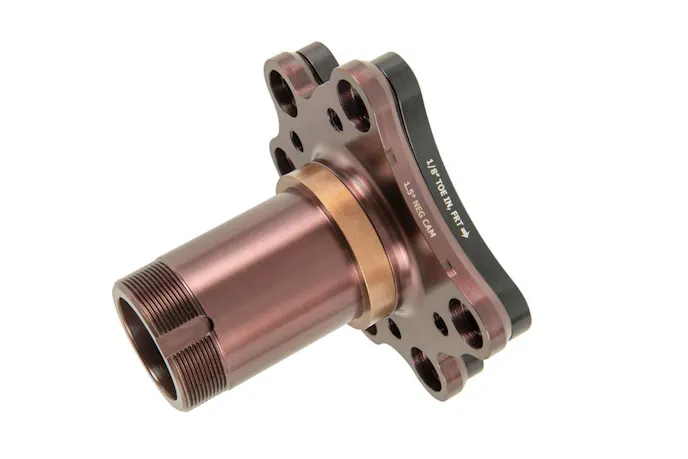
Independent spindles come in 0.5-degree, 1.0-degree, 1.5-degree, and 2.0-degree negative camber options. Toe plates come in zero, 1/16-inch, or 1/8-inch settings per side. That works out to zero, 1/8-inch, or 1/4-inch of total toe. Negative camber tilts the top of the tire in toward the chassis, which helps a pro-touring car keep more contact patch planted through hard cornering. Toe adjustment fine-tunes how the rear tires balance straight-line stability against cornering grip. The spindles and plates simply bolt on, so changing the camber or toe setting later is as easy as swapping components. Builders don’t have to rebuild the housing, which gives them real versatility as a chassis setup evolves.
ABS and Brake Compatibility
Strange Engineering also offers an option for Mustang-based builds. It supplies custom reluctor rings and mounting hardware that let the Pro Touring Floater Kit work with a 2005 through 2010 or 2011 through 2014 Mustang ABS system. This option only applies to new floater kit orders. It requires the complete Mustang ABS system, minus the reluctor rings, plus the specific year of the system in use. That kit includes the reluctor rings (F5056M), the mounting screws for the ABS sensor (F5056O), and the adapter needed for the 2011 through 2014 sensor (F5056N). That detail matters for anyone building a pro-touring Mustang who wants to keep factory ABS functionality after installing the floater kit.
Installation Considerations
Both the standard and cambered spindle configurations work with housings using 3-inch or 3.25-inch OD tubing. Strange machines the included spindles from 4130 steel with a 2-inch OD to provide rigid support for the hubs and bearings. Builders who would rather not tackle the swap themselves have another option. Strange Engineering offers labor-only installation for the standard Pro Touring Floater spindles (H1130SF) and the cambered version (H1130CSF). That labor cost is worth factoring into a build budget alongside the parts themselves.
The full-floating hub design, the axle material options, and the ability to dial in camber and toe without a full housing rebuild add up to a real alternative. Builders get away from the flange failures that come with a conventional rearend. The kit stays adaptable, too, across a wide range of pro-touring and drag-and-drive builds, whether the goal is a weekend autocross car or a full-time road course build. Between the standard kit, the cambered spindle option, the axle material choices, and the matching brake packages, Strange Engineering gives builders a way to spec the rearend around how the car actually gets driven, rather than settling for a one-size-fits-all setup.
You might also like
Skip The Catalog Headache Thanks To The Massive Launch Of JEGS’ New Website
Shop for performance upgrades and custom restoration components using an entirely rebuilt digital storefront designed for true gearheads.