
There’s something depressing about loving a car with no motor. It’s like loving a dog with no legs. You’d love to take it out and play, but that’s just not going to happen anytime in the foreseeable future. OK, the analogy might be flawed, but you get the point. Until we can piece together the powerplant we truly long for, our trusty ’69 Dodge Charger R/T clone ain’t going anywhere fast.
So what does that leave us with? Everything else, apparently. After finishing up Kong’s traction bars, hooking up our emergency brake cable, and routing our brake lines, we figured we’d leap right ahead of schedule and finish up the Charger’s interior because if we weren’t going to be driving it any time soon, we figured we’d like somewhere nice to sit and make “vroom, vroom” sounds like we did when we were 10.
Starting From Not-So-Scratch
Although we picked up our Charger for a paltry $1,200 back in 2003, it came surprisingly complete. The seat frames, door panels and dash were surprisingly complete for being relatively abandoned since the early 1990s in a boat and RV storage lot in Bakersfield, CA, so we had a surprisingly good foundation to start with.
As to be expected, the headliner, carpet, seat foam and covers, dash pad and other “wearable” areas were in need of replacement. We picked up replacement seat covers and foam, carpet, a headliner, package tray and other soft items.
Unfortunately, our “restoration in a rattle can” door panel repair job just didn’t cut the mustard, so we needed to branch out.
Fatefully, the same company from which we purchased all of our aforementioned interior parts, Legendary Auto Interiors, also features a fantastic restoration service.
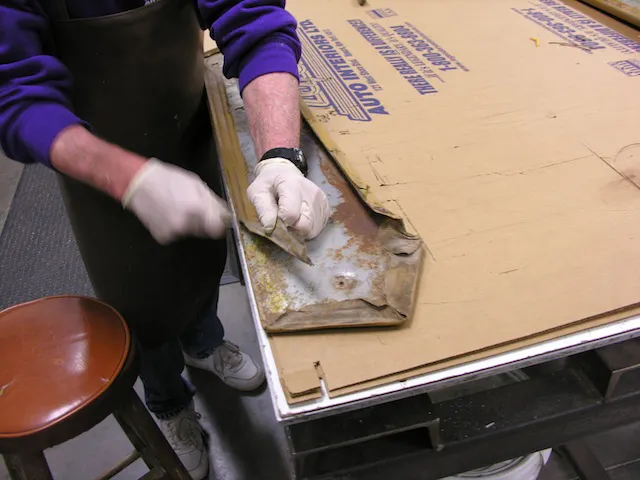
We shipped off our upper and lower door panels to their Newark, New York (not New Jersey) facility where their skilled craftsmen and women stripped off the factory vinyl covers and yellowed, spongy foam and rebuilt our panels from there up. Starting with the bare metal base, Legendary’s techs cleaned the surfaces and reapplied a new coat of glue before attaching the pre-molded replacement foam.
Good Help Is Easy To Find These Days
About eight months ago, we finished up the seats and tracks thanks to Tito’s Upholstery, here in Temecula, California. When it came to hanging the headliner, door panels, package tray, and all that jazz, we needed to find a slightly more specialized shop thanks to the obstruction of our 6-point Competition Engineering cage.
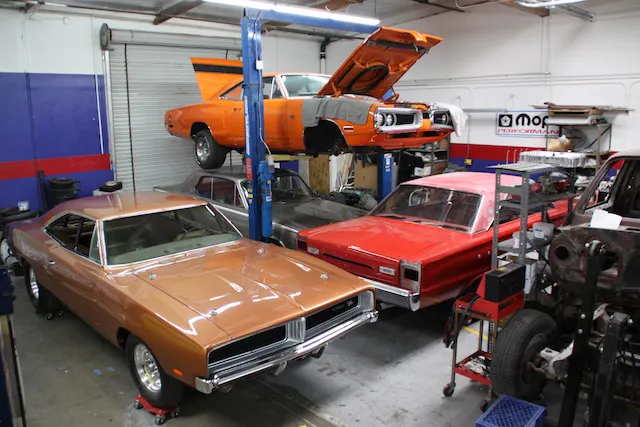
We reached out to Motech Performance – one of the most talented Mopar-specialist shops we’ve encountered – who replied, “Yeah, we could do that.”
In fact, Motech’s “Yeah, we can do that” attitude goes for just about everything. Judging by the cars simply sitting in their shop, these guys can tackle just about anything.
When we rolled ‘Kong into their garage, we encountered a 100-point restoration ’70 Plymouth HEMI ‘Cuda in F6 Green with white interior and a floor shift automatic sitting beneath a resto-mod street/strip appropriately HEMI Orange ’70 HEMI-powered Super Bee, a customer’s four-door ’64 Continental and a turbo-454 ’69 C10 pickup waiting for paint. While they pride themselves on their Chrysler prowess, clearly they can do it all.
Getting a Head(liner) Up
Owned and operated by partners Jason Muckala and Chris Fields, Motech knows their way around vintage Detroit iron, be it building engines or touching up the finer details, such as interior restoration. Chris explained that, “The nuts and bolts of restoring [your] interior is easy. But it takes somebody who really knows the car to make sure its right. There’s little details that interior shops can leave out, whereas we don’t.”
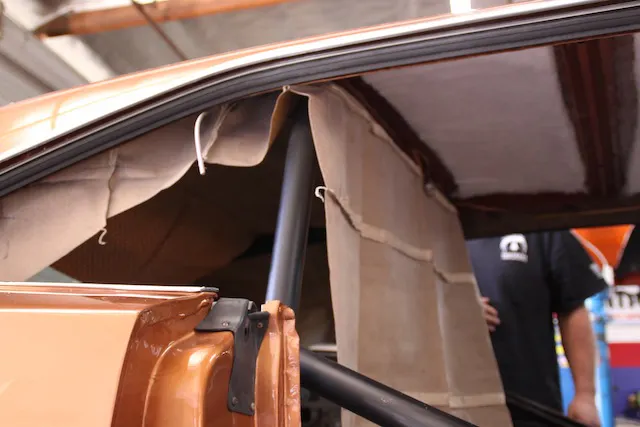
Hanging a headliner in a Mopar is as easy as counting to six; a sequence of six metal bows stretch across the width of the ceiling helping the soft material keep its arced shape.
Two smaller bows do likewise for the massive C-pillars while serrated teeth at the windshield and screw-in retainers on each side keep the headliner taut. Chris used a series of rubberized clamps to position the headliner before finally fixing it permanently.
Due to the Charger’s long, rakish C-pillars, the headliner requires special triangular panels to either be glued directly to the headliner and clip into the inner roof liner, or do as both Motech and Legendary suggests and use prewrapped panels that attach to the inner liner over the headliner, both securing the headliner and looking great.
Paneled In
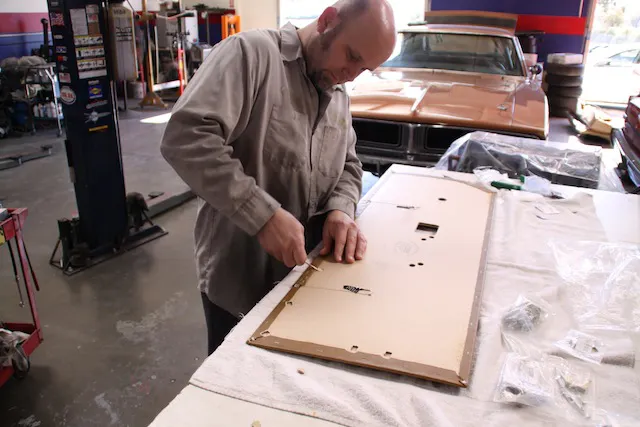
Originally, we had shipped our lower door panels to Legendary for the same treatment as our upper pads. Unfortunately, 50 years of moisture, use and misuse reduced our factory cardboard to misshapen pulp, so Legendary suggested we replace the panels completely, a wise choice. The replacement panels look just as good as the factory pieces and are made tough, so you won’t be replacing them again any time soon.
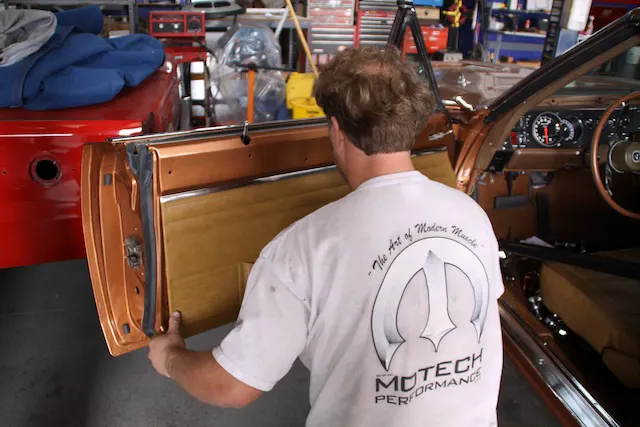
Because of the number of orders asking for custom interiors, Legendary doesn’t automatically punch out the cardboard backing for the retaining clips, arm rests or the window regulators.
The holes for them are perforated in the backing for easy removal though, and Legendary even includes the small tool to pop them out easily. A skilled hand with an X-ACTO knife or razor blade can cut the holes in the vinyl from the backside with no problem.
From the assembly line, most Mopars came with a clear plastic covering that separated the exposed cardboard from moisture and the elements. We didn’t have the foresight to keep those and couldn’t manage to find reproduction replacements, so we went without.
Buttoned Up But Not Quite Finished
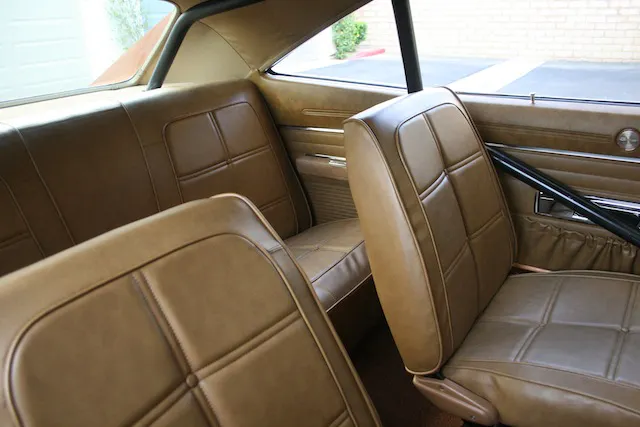
With our new door panels on, it was time to flesh out our interior. Although our arm rests were in pretty decent shape, our bases were junk. While there are companies rechroming plastic these days (can you believe it?), we opted to go the safe route, and go to Classic Industries yet again.
Classic Industries’ new Mopar catalog has been a smash success for both the company and for Mopar enthusiasts looking for another outlet for all their restorative needs. In fact, so much so, that Classic Industries’ own CEO, Jeff Leonard beamed, “We’re planning on expanding the catalog another 30-to-50 pages within the year.”
We picked up new arm rest bases, window regulator grommets, cat whiskers (window felts), some more door clips (they inevitably disappear), the rear window plastic trim, which needs to be trimmed and painted to match your particular car’s interior color, and sideview mirror remote.
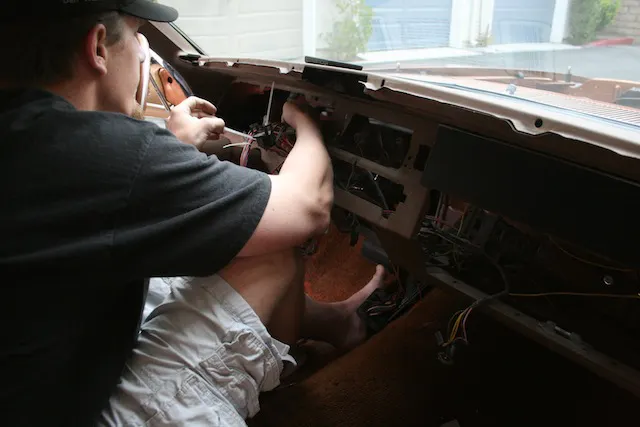
It’s the details that make a car build special, and we’re pretty dang happy with our final product. While we’ve got our interior looking pretty dang nice, we’re still not quite done yet. We’re going to have one more segment on Killer Kong’s interior focusing on the dashboard, and how Just Dashes, Classic Industries, Legendary Auto Interiors, and DTM Racing got our wicked-cool Mopar looking and operating at its very best.
You might also like
California Man Seeks Corvette Guinness World Record For Long Ownership
Bill Hatch pursues a Corvette Guinness World Record with his 1957 roadster. The 94-year-old driver has owned the car for 69 years.