


Pontiac built the GTO, LeMans, and Tempest on the same GM A-body platform from 1968 through 1970. More than five decades later, the factory fuel tank on most of these cars belongs on the replacement list. Rust, pinhole leaks, and cracked seams are common after this many years on the road. A compromised GTO fuel tank is not something to drive around on.
Tanks, Inc. builds direct replacement tanks for these A-bodies. Options include original-style carbureted tanks and EFI-ready versions built for fuel injection. The company also offers the sending units, straps, and pump hardware needed to finish the job.
Picking the right GTO fuel tank starts with the model year. The next decision is whether the car stays carbureted or moves to electronic fuel injection. Here is a rundown of what is available for 1968 through 1970 GTO, LeMans, and Tempest models, along with the supporting hardware that rounds out the fuel system.
Carbureted GTO Fuel Tank Options For 1968-1970
For owners keeping a carburetor under the hood, Tanks, Inc. offers three GTO fuel tank options that cover the full three-year run of GTO, LeMans, and Tempest production.
The TM34A fits 1968-1970 GTO, LeMans, and Tempest models. It is built from die-stamped galvanized steel with a silver and gray finish. The tank holds 20 gallons and includes two vent pipes. It measures roughly 39.75 inches long, 25 inches wide, and 7.75 inches deep. Unlike later tanks in the lineup, the TM34A does not come with a filler neck. An owner will need to source or reuse an existing one.
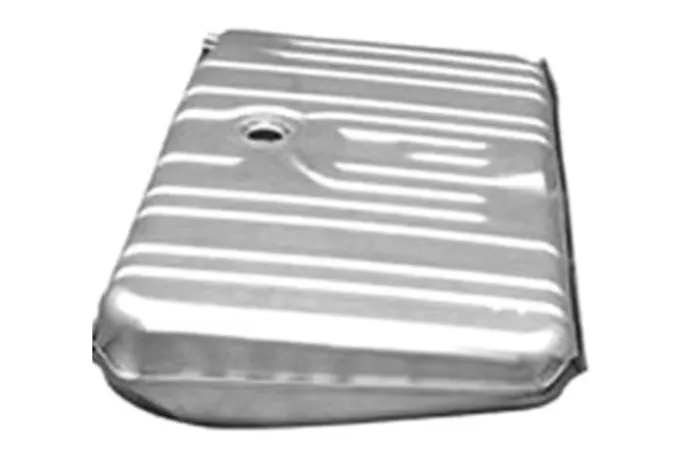
The TM34D narrows the fitment to 1969-1970 GTO, LeMans, Tempest, and Grand Prix models. It shares the same 20-gallon capacity and overall dimensions as the TM34A. However, it ships with both a filler neck and a vent pipe already in place.
The TM34M covers 1970 GTO, LeMans, and Tempest models exclusively. It matches that same footprint and also arrives with a filler neck and vent pipes included.
All three carbureted tanks use the stock mounting points and original-style straps. That means the swap should not require any cutting or fabrication on a stock floorpan.
EFI-Ready GTO Fuel Tank Options For Fuel Injection Conversions
Plenty of GTO, LeMans, and Tempest owners are swapping in modern fuel injection. Tanks, Inc. built a matching set of tanks around that trend.
The TM34A-T covers 1968 GTO, LeMans, and Tempest models. The TM34D-T fits 1969-1970 GTO, LeMans, Tempest, and Grand Prix models. Both use the same galvanized steel construction as their carbureted counterparts, finished with a silver powder coat. Each relies on a two-piece neck design paired with a 2-inch inside diameter rubber hose for the fuel fill connection.
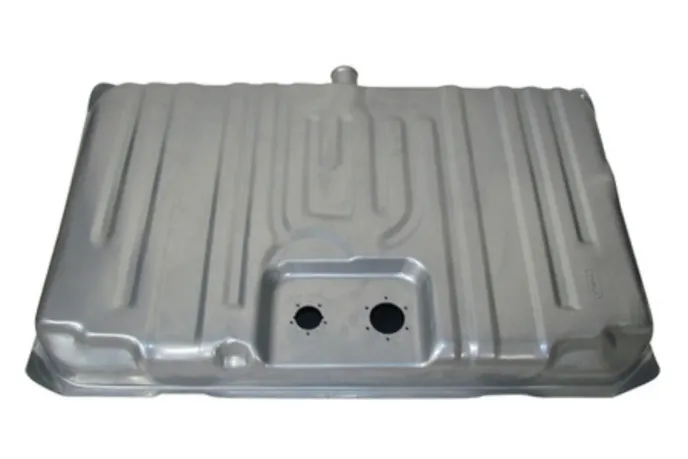
Inside, both tanks use internal baffling built around a 4.8-liter dual-tube baffled fuel tray. That tray keeps fuel pooled around the pump pickup during hard cornering or braking, so the pump does not run dry. The fuel pump and sending unit sit recessed into the tank. No cutting or modification to the trunk floor is needed to clear either component.
Both EFI tanks are set up for Tanks, Inc.’s GPA 2 and GPA 4 series fuel pumps. The company does not recommend them for throttle body injection or other high-flow pump applications. On the sending side, they accept aftermarket five-bolt fuel senders across multiple ohm ranges. Tube or reed-style senders in the 6-inch length also work. From outside the trunk, both tanks are designed to look like an original equipment manufacturer (OEM) piece once installed. Tanks, Inc. built both tanks with pro-touring, autocross, and road racing use in mind, though the internal baffling works just as well on a car that never sees a track.
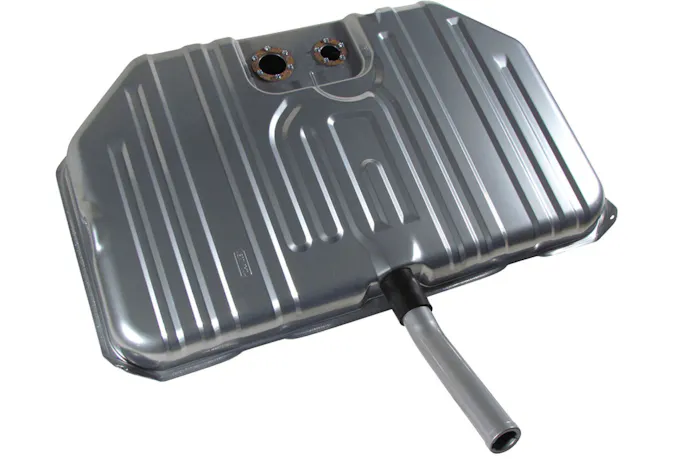
For cars running mini-tubs, Tanks, Inc. also offers the TM34DN-T. This is a notched-corner version of the 1969-1970 EFI tank. The corners are notched 7 inches inward and 7 inches back to clear wider rear tires. The tank runs about 1 inch deeper at the front than the standard EFI tank, while keeping stock depth at the rear. Overall depth comes to roughly 8.75 inches, versus 7.75 inches on the standard tank. It uses the same internal baffling and fuel tray as the other EFI tanks. However, it is rated for Tanks, Inc.’s GPA-series pumps across a wider flow range, and it comes with longer mounting straps to match its notched shape. The added rake at the front is meant to help route fuel toward the pump pickup under hard braking.
Sending Units And Mounting Hardware To Finish The Job
A fuel tank swap on a car this old usually means replacing the sending unit and straps too. Reusing decades-old parts is rarely worth the risk.

Tanks, Inc.’s FG91B sending unit fits a wide range of 1968-1970 GM A-body cars. That list includes the GTO, LeMans, and Tempest, along with Buick GS, Skylark, and Special models. It also covers Chevrolet Chevelle, El Camino, and Monte Carlo, plus Oldsmobile Cutlass and F85 models. The sender reads across a 0-90 ohm range and uses a 3/8-inch pickup tube with a built-in strainer. It includes a 1/4-inch vent fitting, along with the O-ring and lock ring needed for installation. It is built from stainless steel rather than the coated steel found on original units, which should hold up better over another few decades of service.
Mounting straps matter just as much as the tank and sender. A rusted or stretched strap can let a tank shift or sag over time. The ST49 strap set is built from e-coated steel. It fits a broad range of 1968-1972 GM A-body cars, including the GTO, Grand Prix, LeMans, and Tempest. Coverage also extends to Chevelle, Malibu, Monte Carlo, El Camino, GMC Sprint, Skylark, Special, GS, Cutlass, 442, and F85 models. Each strap measures 31.875 inches long, and the set includes two straps, enough for a complete installation.
Retrofitting An Internal Pump With The PA-Series Module
Not every GTO fuel tank swap calls for a dedicated EFI tank. For those keeping an original-style tank while still wanting an in-tank pump, Tanks, Inc. offers the PA-Series In-Tank Fuel Pump Module.
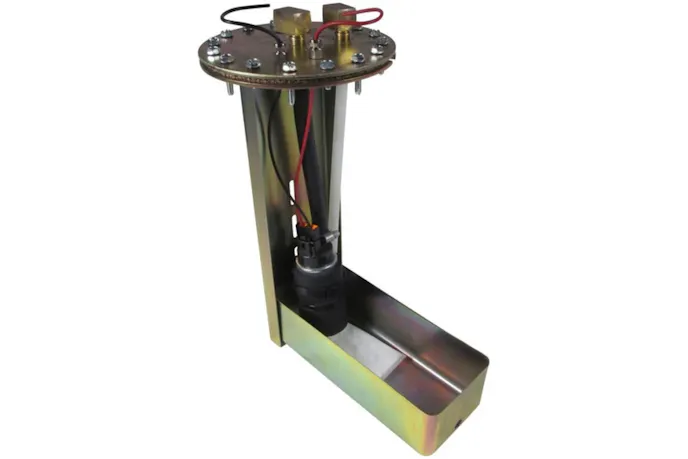
The kit retrofits a pump capable of running up to 100 psi into a tank that was never designed for one. That helps eliminate the vapor lock and cavitation issues that show up with an external fuel pump. A reservoir tray built into the module keeps fuel around the pump inlet. This prevents the fuel starvation that plagues non-baffled tanks under hard acceleration or cornering.
The module is built around genuine Walbro fuel pumps, and it comes in several versions depending on the application. The PA-2 and PA-4 pumps are rated at 190 LPH and 255 LPH, respectively, with the PA-2 supporting applications up to roughly 430 horsepower and the PA-4 stretching to about 630 horsepower. Built specifically for throttle body injection setups, the PA-TBI version flows 109 LPH. Poly-tank versions of each pump, denoted with a “P” suffix, are available for Tanks, Inc.’s UT, UT-H, and F100 tanks. Those particular tanks do not require the “P” suffix pump, since they are already set up to accept it.
Every PA-Series pump is a gerotor-style unit rather than a turbine-style pump, so it is not compatible with pulse-width modulation (PWM) speed control. The module connects using 1/4-inch NPT fittings for the supply line, return line, and vent, and a wiring harness is included for the in-tank pump. Installation requires a minimum tank depth of 6 inches, and it works without modification in tanks up to 11.5 inches deep. A fuel pressure regulator is not included with the kit, so that will need to be sourced separately as part of the overall fuel system build.
Between the carbureted tanks, the EFI-ready versions, and the supporting sending units, straps, and pump hardware, a 1968-1970 GTO, LeMans, or Tempest owner has a full menu of options. The goal might be a bolt-in stock replacement, or it might be a full EFI-ready setup built for a modern engine. Either way, matching the GTO fuel tank to the model year and fuel system first will make the rest of the install go a lot smoother.
You might also like
UPDATE! Grabber Orange Boss 429 Mustang Sells For $429K
The exterior is finished in Grabber Orange, one of 68 so finished, but it is one of only seven in this hue with a white interior.