
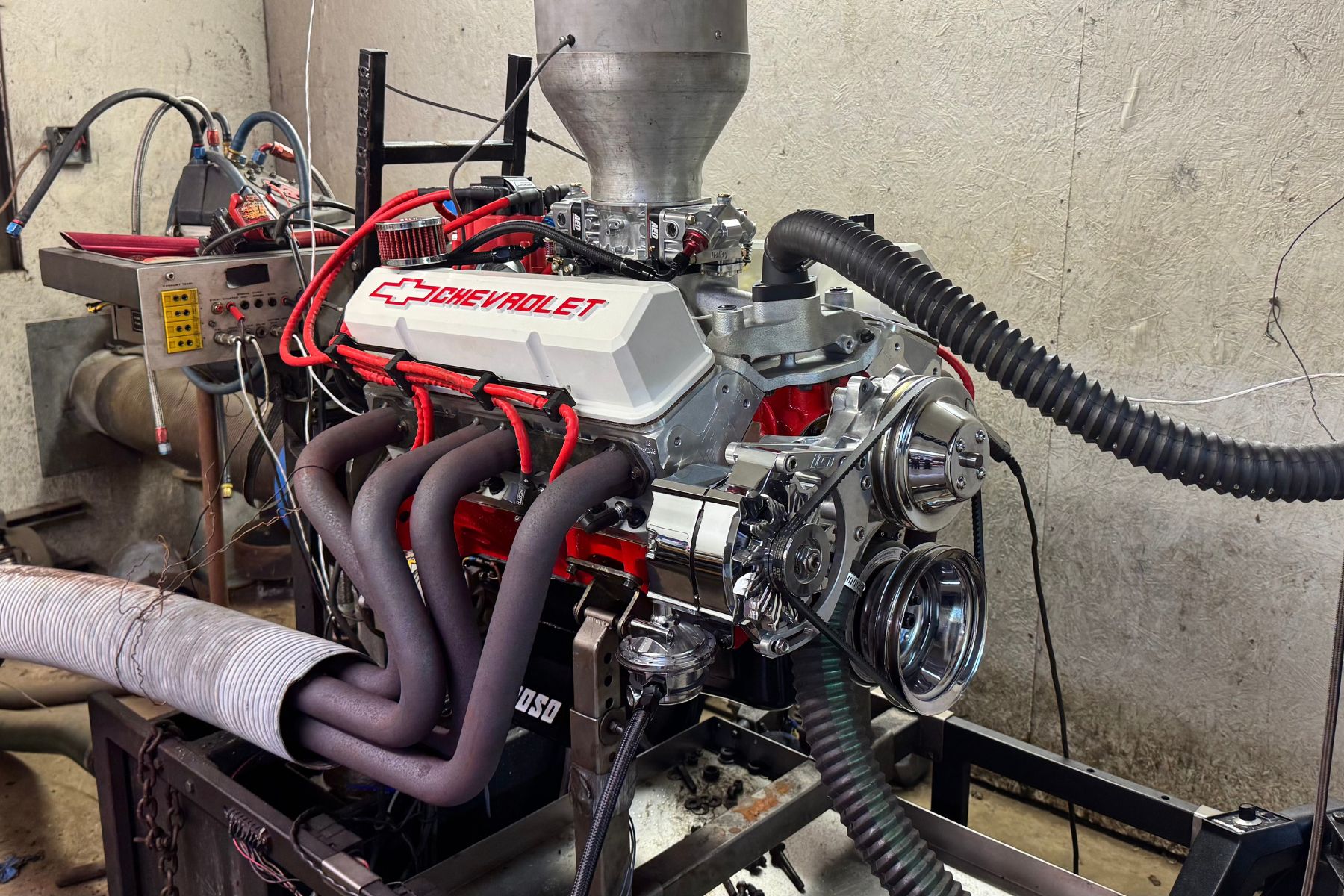
Project Mighty Mouse’s spotlight moment is finally here, and it only took a pandemic, a handful of surgeries, and a newborn to get us to the dyno. If you’re just catching up, we’ve been building a 327 ci small-block Chevy for my first car from high school, a ’77 Chevy Nova. The 327 dyno session at Engine Connection was the final exam for a build that has followed me through so many different phases of my life, and the engine has seen quite a few phases of its own along the way. This article has been years in the making, so grab a seat.
From A $300 Swap Shop Find To A 7,000 RPM Build
The engine has a backstory worth telling. My then-girlfriend-now-wife bought it off the swap shop around 2018, before COVID, as a college graduation present. For $300, she got the 327 along with a spare transmission and some extra parts to sell, which is still the best return on investment anyone in this household has ever made. The engine then suffered through a few different college-budget rebuilds as I went on to get my bachelor’s degree, and you can probably guess how well budget parts held up.

Eventually, it developed a knock that a machine shop couldn’t identify. Cheap budget parts were the most likely culprit, but we’ll never know for sure. That’s where this version of the engine started, and the goal was simple on paper: 500 horsepower and the ability to spin past 7,000 rpm without the engine grenading itself. My hopes were closer to 550 horsepower, but 500 was the quiet goal.
This version took a few years to complete, and not for lack of trying. At first, COVID caused a shortage of available 327 pistons, then I had to undergo four facial surgeries for skin cancer, and toward the end, I had spine surgery and a newborn baby at home. Heck, even the original shop that machined the block is now out of business, so if anyone wants to compare notes on long-term projects, I’ll pull up a chair.
If you want the full rundown of what went into this engine, you can catch up on the Project Mighty Mouse series on ChevyHardcore and the Howards Cams setup we built for RPM on Street Muscle. Since that last article, the only change has been adding the carburetor to the equation, which was the final piece of the puzzle.
AED Competition Builds A Custom 750 CFM Carburetor


We called up the guys at AED Competition, shared our engine specs with them, and got a custom 750 cfm carburetor in return. AED had something new it wanted to try on our 327. “We have a brand-new billet annular booster we really like here and want to try this with a 750 HP main body, because this booster should provide a wide power band,” AED said.
According to AED’s carb card, the carburetor was set up for pump gasoline on a new core, with 73 primary jets and 82 secondary jets. It uses 0.070-inch primary and secondary idle bleeds, 0.033-inch primary and secondary high-speed bleeds, a 4.5 primary power valve, and 0.035-inch squirters on both sides. AED also wet-flowed and test-ran the carb, and it carries the company’s Pro-Series modifications.
Baseline Pull Shows Where The 327 Dyno Numbers Stood
Because of the amount of time this engine sat and how long it went between parts installs, we played it safe before the first 327 dyno pull. We had Chris Zeller, the owner of Engine Connection and the dyno we were using, take the oil pan off, double-check everything, and make sure everything was safe to spin up.
With our 7,000-plus rpm goal in mind, we started off slow to make sure everything was properly warmed up. We began with 36 degrees of total timing, thinking we would need to come down to the 34 area, but we figured we’d just see what 36 did first. The first run was a light pull from 3,200 to 6,100 rpm to get a good baseline reading, and the 327 made 402.9 lb-ft of torque at 5,600 rpm and 444.0 horsepower at 5,800 rpm. That gave us a clear picture that the 500-horsepower goal might not get reached, but it also showed we had a lot more room to push.

The baseline 327 dyno pull also showed us a weird air/fuel ratio between 3,500 and 5,000 rpm. The engine ran in the 11:1 area from 3,200 to 3,400 rpm, then stepped to 13:1 and 14:1 before leveling back out after 5,000 rpm.
Our first thought was to throw on a 2-inch, four-hole spacer to see if it would help lean things out a bit in that range. Doing so cost us roughly 15 to 20 horsepower across the board. We even tried bringing the timing down to 34 degrees total, and the engine just didn’t like it. Smaller jets were also a no-go.

More Fuel, More Timing, And More RPM
With the spacer removed, we took some time to analyze the 327 dyno data. Chris gave it some thought and decided it was time to give the engine more fuel, more timing, and more RPM. This 327 was built to move air and rev, so it only made sense to give it what it was asking for.
We bumped the timing to 38 degrees and added two jet sizes front and rear, which made for 75s in the front and 84s in the rear. We also decided it was time for 7,000 rpm instead of 6,800.
This is when the engine came alive. It survived the trip to 7,000 rpm just like it was intended to and made 466.5 horsepower at 6,600 rpm along with 403.0 lb-ft of torque at 5,100 rpm. Better yet, the 327 held more than 440 horsepower all the way from 6,000 rpm to the 7,000-rpm limit, which is exactly the kind of top end this engine was built for. The air/fuel ratio also settled in between 12.28:1 and 13.38:1 from 6,000 rpm on up.

Turning The 327 Loose To 7,200 RPM
The 327 dyno data showed a slight chance we could add more fuel to the front and get some more power out of it, so we bumped the front to 77 jets and set the rev limiter to 7,200 rpm.
I watched the tach climb to 5,000 rpm and heard the engine beautifully belching out the sounds of wide-open throttle, and then I realized we still had 2,200 rpm to go before it hit the 7,200-rpm redline. It was very similar to those moments when you lean too far back in your chair and your life flashes before your eyes. Every moment of building this engine flashed before mine, and all I could hope was that any damage that might happen wouldn’t be bad enough that it couldn’t be rebuilt again.
Yet again, it survived the pull. This run with the bigger jets didn’t match the 466.5-horsepower peak, but it showed us something different, because the engine wanted to keep going past 7,200 rpm. Horsepower climbed from 439.6 horsepower at 6,600 rpm all the way to the limiter, making peak power at 7,100 to 7,200 rpm and topping out at 459.8 horsepower. Peak torque came in at 406.1 lb-ft at 5,400 rpm.

We all agreed it probably could have been pushed further. After reviewing the power levels, though, it was clear our luck didn’t need to be pushed any further, since we could have kept raising the RPM limit until something bad happened, and nobody wanted that line on the dyno sheet.
Our 327 Lives Up To The Mighty Mouse Name
After that pull, we decided to wrap up the 327 dyno session. It was clear we weren’t going to hit the 500-horsepower goal, but we successfully built the kind of high-revving engine the Mighty Mouse nickname was always meant for. Chris mentioned his dyno is a bit tight and has a habit of reading lower than other dynos, but we don’t want to focus on that. The numbers we have say this is a 466.5-horsepower engine, and speculation isn’t what we do.

I would love to say I have a 500-horsepower 327, but that will have to wait for another day. Maybe the story was never about the final horsepower number, but the horsepower we made along the way. For now, the 327 build is done and will be prepped to drop into its home, my ’77 Chevy Nova. The Nova has been down long enough that 34 horsepower isn’t worth chasing, and I just want to get back behind the wheel of my car.
You might also like
New FAST XCR LS3 Street Intake Promises Big HP, Torque Gains
The XCR promises gains up to 45 horsepower and 70 lbs-ft of torque over similar manifolds, which is perfect for the street enthusiast.