Nearly 60 years ago, this 1968 Chevy Camaro was tearing up the dragstrip. Now, after decades in storage, the former race car is back with an entirely different mission. Born at GM’s Van Nuys assembly plant in Southern California, the ’68 rolled off the line wearing Tripoli Turquoise Metallic, packing an unknown factory V8 and outfitted with the upgraded RPO Z87 Custom Interior package. Its VIN and cowl tag confirm its factory-born credentials.

Chevy unleashed the first-gen Camaro as a Mustang-eater, but once this pony car’s original owner took delivery, there was bigger prey in mind. Stripped, modded and track-ready, the Day Two racer left its rubber on the asphalt at the NHRA Black Hills Dragway in Belle Fourche, South Dakota.

The thinner air of South Dakota’s Black Hills Dragway didn’t slow its ambitions. A surviving time slip tells the tale. An 11.98-second quarter-mile pass shaved multiple seconds off documented factory performance. Its 112.07-mph trap speed outpaced the stock V8 options by 8 to 27 MPH, depending on the engine option.
Then, with less than 1,000 race miles under its belt, this Chevy went silent. Years later, it was goin’ back to Cali. The former drag car now calls a port city in the Golden State home. Its roll cage is history. So are the slicks and giant air-gulping scooped hood, swapped for streetable shoes and an original-style ’68 ice cube tray hood. But the guttural growl of its racing past is unmistakable.

Drags Strips To Daily Driving
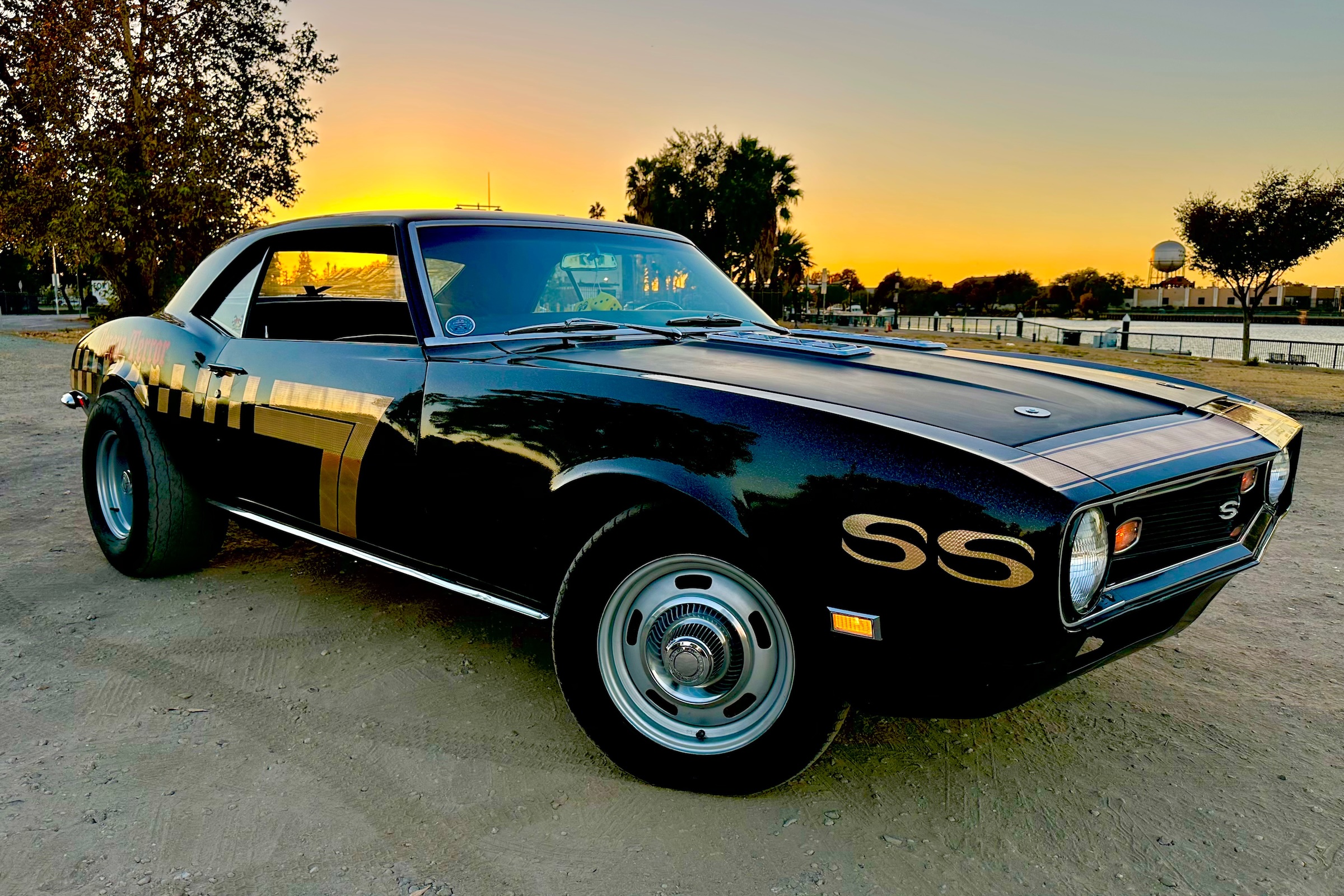
Still proudly wearing its bold late-’60s racing graphics and other hints of its competition days, the car known as Torque Terror is no trailer queen. A surviving piece of drag-racing history, the 1968 Chevy Camaro SS was purchased by Joe Soto Jr. On delivery, the odometer still showed only 979 miles, accumulated one quarter-mile at a time.

Now serving as the high school teacher’s daily driver, it has a few thousand more miles on it. However, it has made Soto Jr.’s morning commute every bit as much fun as a quarter-mile run. In addition to more miles, a few other details have been changed. Some mods predate Soto Jr.’s ownership, including the roll cage removal. Others reflect his plan for the Camaro’s new street-legal life.
“The Day Two racer, he just completely stripped everything out of it — anything that he didn’t need for racing — he stripped it,” said Soto Jr. “He took out the windshield wipers, the mirrors, the visors. You know, it’s funny. He even took the door sills out and the little plastic vents. He took those out too.”

Although the VIN confirms the Camaro was born with V8 power, it is unknown which factory-packed version was initially installed. Currently the Camaro is powered by a 427 cubic-inch Rat motor. Power is delivered through a Muncie four-speed manual transmission, which replaced the factory three-speed manual.
“I rebuilt the shifter on it,” he added.
Soto Jr. also upgraded the fuel delivery with a Holley 750-cfm Double Pumper. He added Borla mufflers to the exhaust.


“As soon as I was able to start the car in my driveway, I did and it was no muffler/open header,” Soto Jr. explained. “My wife said all the dishes were rattling inside the kitchen, and I could just imagine my poor neighbors. I ended up getting the X-pipe for it and I put electric cutouts. Then I put sound-deadening inside the car and with that and the insulation and carpet even with the open pipes, I could still have conversation in the car.”


Soto Jr. estimates the engine produces approximately 650 horsepower, with a potential range of 600 to 700 horsepower and 500 to 600 pound-feet of torque. These figures are estimates, as the engine has not been dyno-tested.
“I went and got the correct fan with the fan clutch,” he said. “I put the fan shroud, all the plumbing, the correct Holley carburetor. I put the air cleaner that fits so that I could actually run an SS hood on it.”

Soto Jr. had sleeper ambitions for the big-block Camaro, leaving 396 badging on the air cleaner to disguise the 427 lurking beneath the hood. Then he ordered a personalized license plate reading RATX427. So much for keeping a secret.
I wanted to leave the 396 to fool people, like if I ever race them,” he said. “But then I messed up. Maybe I’ll change my plate again, but I kind of like the look of RAT on there.”

The Camaro retains its original Positraction diff, which was rebuilt by Valley Differential. The shop also replaced the gears.
“The original Posi had 3.31 gears, and the original owner had changed them,” he said. “That car was running 10-second passes at one point with 5.38 gears and that’s pretty amazing for back then. I had the 5.38s pulled out and put 4.11s in.”
At the time of the buy, the Chevy’s driveshaft was MIA. Soto Jr. replaced it with a high-performance model from Denny’s.

“I’m guessing that maybe the original owner twisted it when he used to race it,” Soto Jr. speculated. “I put a driveshaft that could actually handle 2,500 horsepower. It’s actually a driveshaft that’s supposed to be for nitrous cars. I don’t think I will ever get to that level. I’d have to put a big-ass blower on there to get that kind of horsepower. I’m nowhere near that threshold.”

A Drag Suspension On The Street in 2026
The Camaro’s drag-era subframe connectors and traction bars were left intact. Soto Jr. added drag shocks all the way around.
“I got 90/10s front and in the back, I have 70/30s,” he said. “When I take off, the front end lifts up pretty nice and then it comes down slowly. I love how that looks.”

Repeated hard launches and wheelie landings may have taken their toll, leaving Soto Jr. to replace the windshield and other components that he felt were collateral damage from the Camaro’s former track days.
“The windshield was cracked and it made the gearbox really loose, where the pitman arm connects to the gearbox — the steering box,” he said. “I was lucky enough to find a steering box that’s quick-ratio. I used to have to turn the wheel like four times to make a left or a right. Now, it’s basically like one or one and half turns. So, that has really improved the steering.”

Original drum brakes still provide the stopping power. At some point, Soto Jr. wants to make the conversion with Wilwood six-piston fronts.
Rally Wheels & Drag Tires
Chevrolet DB-coded Rally wheels, measuring 15×5 inches up front and 15×10 inches out back, preserve the car’s drag-race stance. Its soft-compound, wrinkle-wall drag tires help it hold on to some of its racing vibe.
“I was under the assumption that 14×6 was the smallest and skinniest Rally wheel that you can get, but I did a search and turns out that they’re these really rare Rallys,” he shared. “And I didn’t even know those existed, but they’re so rare because they only came on ‘67 and I believe ‘68 Impala Super Sports that had the 427 big block and these specific brakes. So, they are super, super rare. And so I’m like, oh, my God, that’s even better than 14×6 because they’re taller and narrower.”

Soto Jr. is storing an original set of drag slicks from the car’s competition days and an additional set of Cragars that he plans for the future.

Back in the day, its factory-applied Tripoli Turquoise had already given way to its drag image, which showed out in black paint with heavy metallic paint and period gold graphics. Well-preserved from its racing heyday, Soto Jr. has no plans to erase that heritage.
“I am going to try to fix some of those little patches that aren’t perfect and then I want to complete the bumblebee stripe on the top where the hood’s at, but it doesn’t have the sides. So my plan is to continue it on the side and then stop and skip over where it says SS and then continue below the SS all the way around.”
Inside The Day 2 Camaro
The black interior, including the Deluxe-style front seats with chrome accents, are still present in the Camaro. The rear seat was replaced, and a center console was added by Soto Jr., along with Moon auxiliary gauges displaying voltage, oil pressure and engine temp.

What’s Next For This 427 Big-Block Camaro?
Soto Jr.’s wish list includes a 6XD sequential racing transmission, or maybe an M22 Rock Crusher, a bigger cam and, down the line, maybe even a 6-71 blower to fill out the original SS scooped hood that he still has. For the immediate future he wants to get different heads and then potentially get it dyno’d.


“If I get the Muncie, I’m going to put in the back and the tail housing and I’m going to replace it with a Gear Vendors overdrive,” Soto Jr. said. “So basically, it would double the gears – instead of four gears, I would have eight. And probably within the next week or two, I’m putting tubular upper A-arms to improve the geometry of the steering.
“And if I put wider tires in the front with those upper A-arms that I want to get, it should be able to carve the road really nice. And then I want to get a bigger cam too. And I’ll probably put the valvetrain girdles that keep the rocker arms from flexing.”
Soto Jr. wasn’t searching for just any old school Camaro. He wanted a ’68, and he wanted one with race history. After 45 years tucked away in a climate-controlled garage, the former drag car became available when the widow of a Day Two racer from the ‘60s and ‘70s decided to sell. It was destiny.
Soto Jr. never knew the original racer, but the Camaro tells his story, connecting two gearheads decades apart who never met. And while he respects its history, he is not about treating it like a museum exhibit.
Now believed to be the first owner to put the former race Camaro’s wheels to the public roads, Soto Jr. has made it his own without erasing one minute of its quarter-mile past. And one day he just may help the ‘68 find its way home to the dragstrip.
“Because, you know – the car – it was a race car originally, so I kind of think, it probably misses it,” he said.
You might also like
Drag Racing Legends To Appear At MCACN 2026
The numerous vehicles Butch Leal raced included a Ford Thunderbolt, Boss 429 Mustang, 427 Camaro, and Hemi Dusters, and a Firebird.