
Just in time for the 62nd anniversary of the April 17 launch of the Mustang comes Robert M. Kennedy’s new book, Mustang Unbridled: The High-Octane History of Ford’s Legendary Pony Car. It’s an in-depth look at the entire history of Ford’s groundbreaking sporty car and its impact on the automotive industry over those six-plus decades.
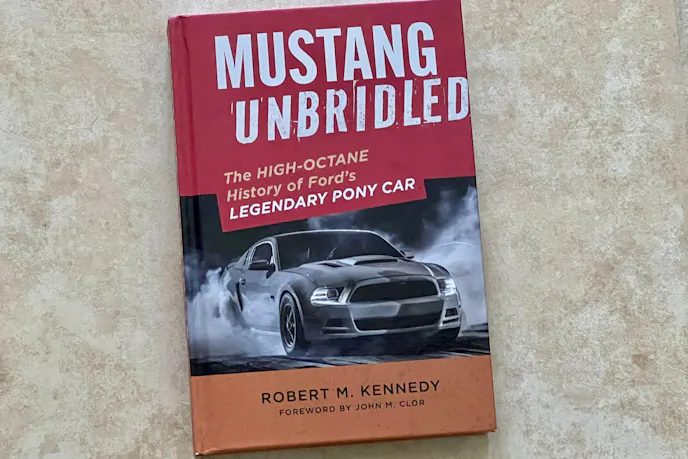
This is an aptly-named tome, as Kennedy’s enthusiasm for the Mustang is as unbridled as the car itself. The author really digs deep into the history of the Mustang — in fact, Ford Motor Company itself — as the book starts with Henry Ford’s birth in 1863 and takes you through his first failures to start an automobile company, right through the success of the Model T and A, World War II and the birth of the Falcon, upon which the Mustang was based.
Many books have captured the early history of the Mustang, the men involved, and the trials and tribulations they faced. Where Mustang Unbridled really shines is that it continues that story right to the current day, with the name, rank and horsepower of all those in charge through S197, S550 and 2024-up S650 of today.
A Serious Car Book
That, in our opinion, makes it truly worth a place on your bookshelf if you are a Mustang historian. Too many books we come across are chock full of large, colorful photos, hackneyed cliches about the car, and precious little substance. I can attest as someone who has written three Mustang/Ford books and six automotive titles overall, that this kind of effort is extraordinarily difficult. That Kennedy has gone to great lengths to get this information makes Mustang Unbridled well worth the purchase price ($32 U.S. from Motorbooks).
Other things that set it apart from the usual books? First, its size. It is not a coffee table sized book. It is basically the size of a novel and reads like one.
There are no photos in throughout the text to distract you from the valuable information being presented. There are 32 pages of significant photos and captions in the middle of the book that cover concept cars, clay model designs, important Mustang historical figures, such as Lee Iacocca and O. John Coletti, and the cars themselves, including race machines and vehicles of particular interest.
Second, if you like the Mustang II, Ford’s controversial replacement for the ‘73 Mustang, this is your title. Kennedy is obviously a fan, and his knowledge of them encyclopedic. He really delves deep into the Deuce, and if that leaves you wanting for more, the Foreword was written by John M. Clor, Ford’s resident historian on the 1974-1978 models. The book actually goes into detail about the intricate changes made to the car over its five model year lifespan, correct horsepower figures (which are often difficult to find for the 302 from ‘75-76), and its rightful place in the Mustang timeline.
We also like Kennedy’s use of comparison road tests, from the old days to today. They offer a unique perspective on how the car performed against their competitors — including four- and six-cylinder models, not just V-8s.
Where does the book fall a little short? Its treatment of the 2009-up Cobra Jet race cars, while historically accurate on the development and features, offers little in the way of how it performed in either NHRA or NMCA (National Muscle Car Association) competition. Historically, these were the most important and significant Mustang drag cars ever (and the most successful), yet more coverage is given to the Mustang Funny Cars of John Force and Bob Tasca III, which are Mustangs in name only.
We also think Kennedy overplays how important the nostalgia aspect is for past four generations’ styling while dismissing the Fox Mustangs of 1979-1993 as outliers for not being slaves to the Mustang/Mustang II styling cues. The Fox Mustangs were perhaps the most important since the originals because they sold like made and brought Ford tons of conquest sales. People who would never consider a Mustang in the past traded their Chevys for 5.0-liter Foxes.
The Mustang survives today because of the Fox-era Mustangs. This is the car that an entire segment of the automotive aftermarket was built upon, had numerous drag race series dedicated to it, and is every bit as important as the ’69 Camaro.
We say buy this book. It’s worth the price of admission, is historically accurate, and just a fun read.
You might also like
1,511-HP Street Machine: John Warren’s Nuclear ’72 Chevy Nova
It's still the same Chevy Nova that Warren drove to school, only it's packing enough power to run with the quickest cars in the country.