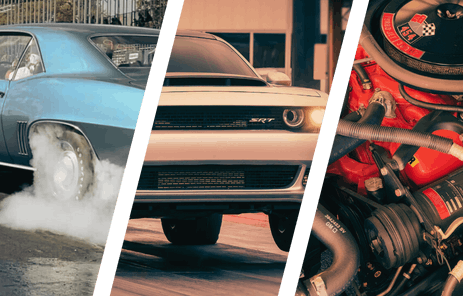

Anyone who has reached into an engine bay of a classic car knows the uneasy feeling of working near a mechanical fan. That belt-driven blade spins constantly whenever the engine is on, whether the radiator needs the airflow or not, and it sits right where hands, tools, and loose clothing tend to end up. Swapping to an electric fan and shroud kit not only solves that problem, but it brings a handful of performance benefits along with it. SPAL builds two dual electric fan and shroud kits, the 12-inch 30102130 and the 11-inch 30102052, that make the swap straightforward for anyone ready to leave the old mechanical fan behind.
Both kits arrive as complete, ready-to-mount assemblies rather than a pile of parts that need to be sourced separately. That matters more than it might seem at first. A cooling system upgrade is only as good as its weakest link, and mixing a random fan with a mismatched shroud, an undersized relay, or the wrong wiring gauge is one of the more common ways a build ends up disappointed with the results. Starting from a matched fan and shroud combination removes that variable before the project even begins.
Safety Is The First Reason To Make The Switch
A mechanical fan is tied directly to the crankshaft through a belt and pulley, so it spins anytime the engine runs, and it spins faster as engine speed climbs. There is no way to reach past it safely while the engine is running, and even when the engine is off, the blade can still move if bumped. Electric fans remove that hazard entirely. Both SPAL units use plastic fan blades instead of steel, and the motors only run when a thermostat or fan controller calls for them. No belt, no constant spinning, no sharp metal edges waiting near knuckles and fingers during routine maintenance.
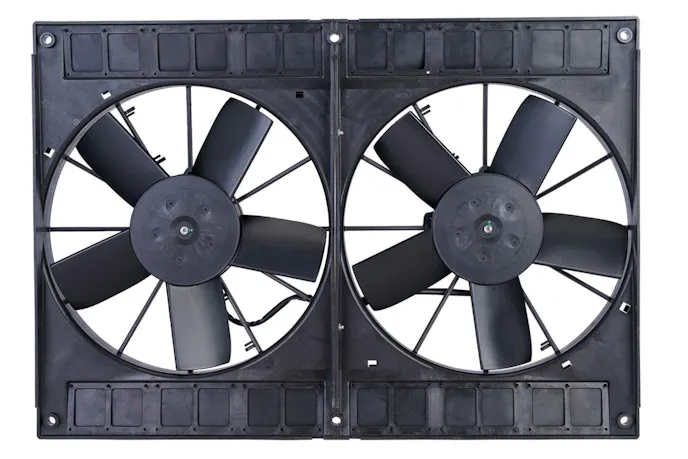
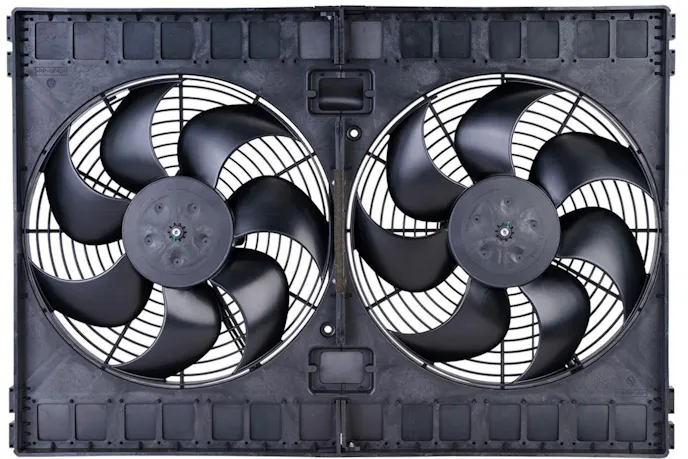
The 30102130 electric fan and shroud kit uses a curved seven-blade design across two 12-inch fans rated at 3,168 cfm combined, while the 30102052 uses a five-blade straight paddle design across two 11-inch fans rated at 2,720 cfm combined. Both are sealed to an IP68 rating, meaning the motors are protected against dust and water intrusion, an important detail for anything mounted directly behind a radiator where road spray and heat are constant.
Horsepower Saved By Losing The Mechanical Fan
A mechanical fan does not just move air. It also pulls power directly off the crankshaft to do it, and that draw exists at every rpm, not just when cooling is actually needed. Depending on fan size and engine speed, a belt-driven fan can eat up a meaningful chunk of horsepower, power that never reaches the wheels. An electric fan runs off the charging system instead of the crank, so that parasitic loss disappears. The engine only asks the fan to work when coolant temperature calls for it, and the rest of the time the fan draws no mechanical power from the engine at all. That is one reason every new car uses this type of fan: Free horsepower, better efficiency, and improved fuel economy — and when the one company more OE’s go to for their fans is SPAL.
Both SPAL assemblies are built for this kind of swap. The 30102130 draws 39.2 amps at 13 volts under no static pressure, climbing to 48.6 amps as pressure across the fan increases, and it calls for a 40 amp fuse per motor. The 30102052 draws 29.8 amps at 13 volts under no static pressure, climbing to 39.3 amps under load, and it calls for a 30 amp fuse per motor. Wiring either one into a properly sized relay and fuse setup is a known quantity rather than a guessing game.
For a guide to how electric fans impact the charging system on your classic, click here for a story on charging system needs.)
Why A Premade Electric Fan And Shroud Kit Beats Building One
One of the trickiest parts of any electric fan conversion is the shroud. A shroud is not optional. Without one, a fan pulls air from the path of least resistance around the edges of the radiator instead of pulling it straight through the core, and cooling performance suffers even with a strong fan behind it. Building a shroud from scratch means measuring radiator dimensions, cutting sheet material, sealing gaps, and hoping the finished piece actually directs air where it needs to go. Get it wrong and the result is an engine that runs hot exactly when it should not, whether that is idling in traffic or sitting at a stoplight after a run down the track.
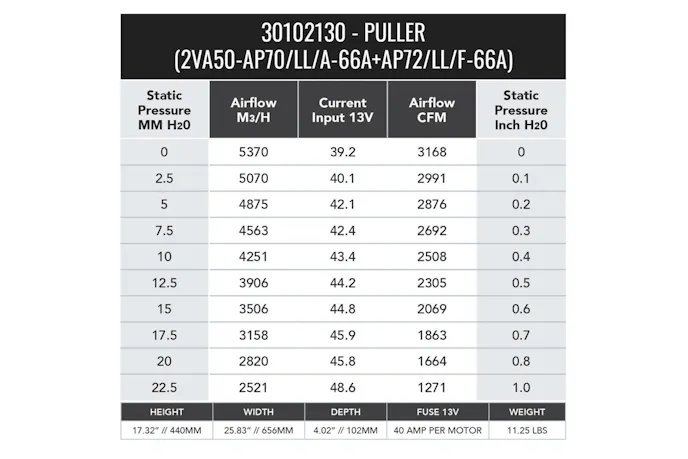
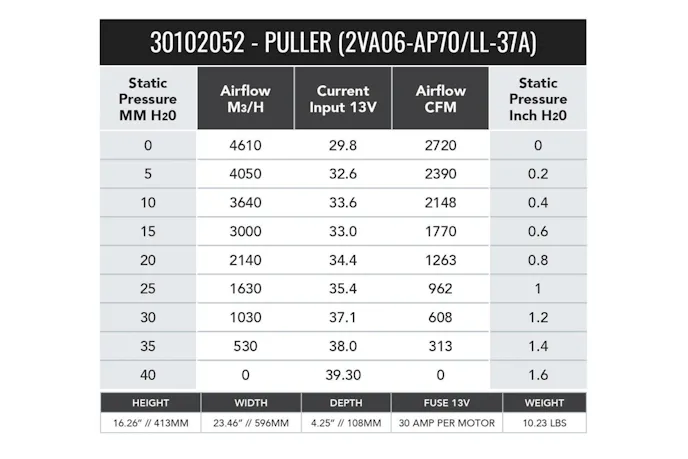
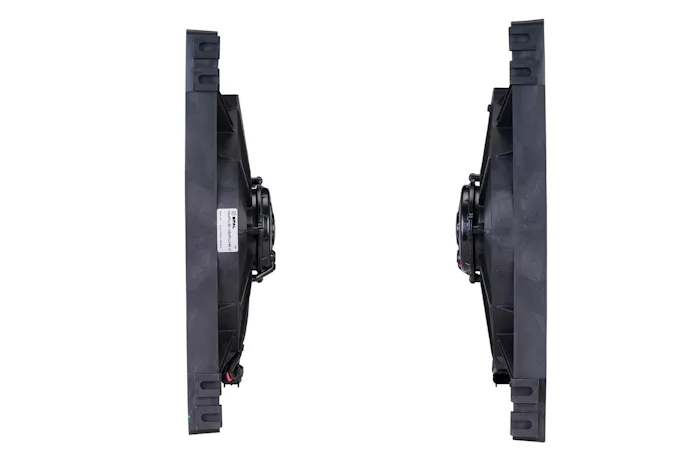
An electric fan and shroud kit removes that risk because the fan and shroud arrive engineered together. The 30102130 measures 25.83 inches wide, 17.32 inches tall, and 4.02 inches deep, and it weighs 11.25 pounds. The 30102052 measures 23.46 inches wide, 16.26 inches tall, and 4.25 inches deep, and it weighs 10.23 pounds. Because the shroud and fans are matched from the factory, there is no need to fabricate anything or second-guess whether the fit will actually seal properly against the radiator. That takes one of the biggest variables in a cooling system upgrade off the table.
Other Advantages Worth Considering
Beyond safety and horsepower, an electric fan setup offers a few more benefits that add up over time. Weight is one of them. A mechanical fan clutch, pulley, and belt-driven fan assembly carries real mass, and removing it in favor of a plastic-bladed electric fan and shroud trims weight from the front of the engine. That is a welcome change for anything built with performance in mind.
Control is another advantage. A mechanical fan spins at a fixed ratio to engine speed no matter what the coolant temperature actually is, which means it can run harder than necessary at highway speed or not hard enough while idling in traffic. An electric fan paired with a thermostatic switch or programmable controller only kicks on when coolant temperature actually rises, which keeps the engine in its ideal operating range more consistently. That same control also helps at idle and low speed, situations where a mechanical fan often struggles to move enough air on its own, particularly in stop-and-go traffic or while staged at the track.
Noise and vibration drop as well. Because the motors on both Spal assemblies are sealed and balanced, running noise stays low compared to a mechanical fan spinning at high rpm, and there is no belt-driven vibration transmitted back through the front of the engine.
Reliability rounds out the list. Removing a belt-driven accessory means one less thing that can fail, slip, or need periodic adjustment. Both the 30102130 and the 30102052 are built as sealed, self-contained units, so once the wiring and shroud are installed correctly, there is little left to maintain beyond keeping the electrical connections clean.
Compatibility with air conditioning is another point worth mentioning. Vehicles running AC depend on consistent airflow across the condenser, and a mechanical fan that slows down at idle can leave AC performance struggling in stop-and-go traffic. An electric fan controlled independently of engine speed keeps pulling air at a steady rate regardless of rpm, which helps both the radiator and the condenser stay in their proper temperature range at the same time. That is a detail that gets overlooked until the first hot summer afternoon spent sitting in traffic with the AC on.
A Straightforward Upgrade With Real Payoff
Switching from a mechanical fan to an electric setup checks several boxes at once. It removes a spinning metal hazard from the engine bay, gives back horsepower that was being lost to a belt-driven accessory, and, with an electric fan and shroud kit like the Spal 30102130 or 30102052, removes the guesswork that leads to overheating from a poorly fitted DIY shroud. Add in the weight savings, better temperature control, quieter operation, and improved reliability, and it becomes clear why so many builders treat this as one of the easiest upgrades to justify.
You might also like
The One That Never Got Away: Original-Owner ’70 Hemi Challenger R/T SE
While many of his peers succumbed to family pressure of selling their muscle cars, Joe hung on to his rare Hemi Challenger R/T for 55 years.