

Automotive Racing Products, Inc. (ARP) is widely recognized as the world leader in fastener technology.” But there’s more to the California-based company than manufacturing fasteners. ARP has devoted an extensive amount of resources on developing a line of products to aid in efficiently and accurately assembling engines.
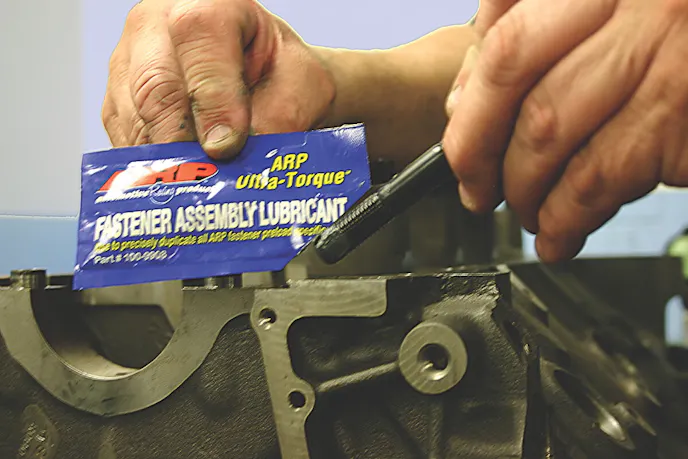
Accurately assembling engines is critical for longevity and maximum performance, and specialized tools make the job easy. Case in point is ARP Ultra-Torque fastener assembly lubricant. Extensive laboratory testing confirmed that popular lubricants like oil, molybdenum and grease have very inconsistent friction properties that cause inaccurate torque wrench readings from one fastener to the next. This is called “preload scatter” and it can lead to problems that range from insufficient clamping force on gaskets to connecting rod and crankshaft failures.

It took years of testing using sophisticated computer-controlled equipment to determine the performance of various lubricants, which resulted in a formula that delivers from 95-100 percent of the desired preload on the first “pull” of a torque wrench. Other lubricants can require up to 10 cycles of torquing a fastener to the desired load, loosening it, and repeating the process until the threads provide optimum engagement.
ARP includes a packet of Ultra-Torque with most kits and it is available in tubes plus 10 and 20-ounce brush-top containers for added convenience. For those applications with a wet deck engine block, you should employ ARP’s Thread Sealer to prevent coolant leakage. It can also be used on pipe plugs, fuel line fittings or other applications requiring a flexible, leak-proof seal.
Block Prep Is Key
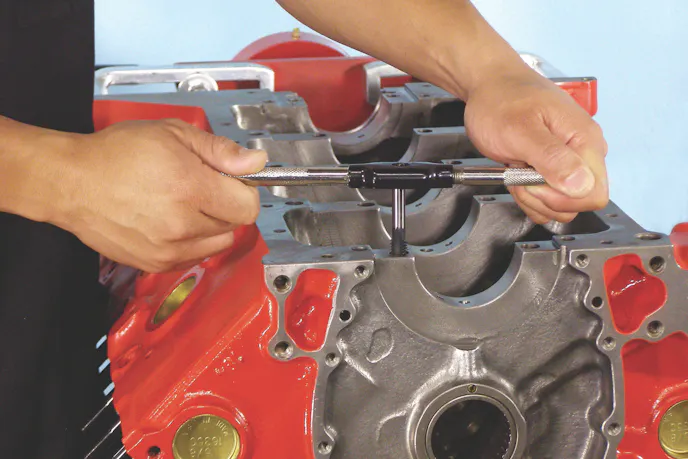
It’s also important to prep the engine block, cylinder head, crankshaft, etc. using special Thread Cleaning Chaser Taps. They are designed to remove debris and not cut the thread. They are available in sets for popular SAE and metric sizes.
History has shown that a large percentage of engine failures can be attributed to improperly torqued connecting rod bolts. Insufficient preload can cause the rod cap to loosen and too much can stress the fastener.
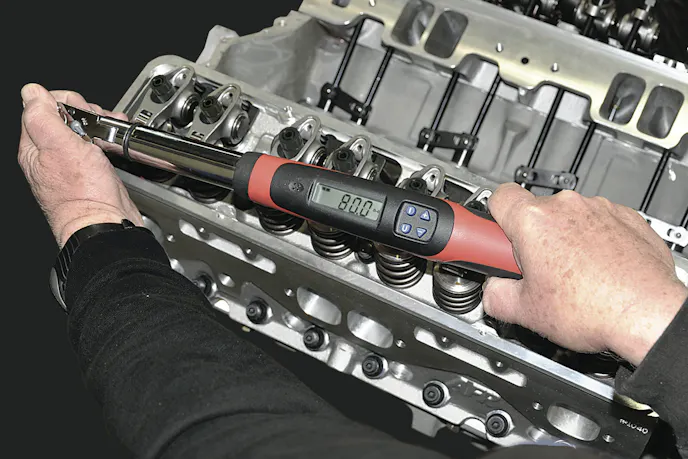
This brings us to a very important reality: Torque wrenches are delicate instruments that are often inaccurate. ARP has offered free torque wrench testing at NHRA National events for many, many years and it’s not uncommon for racers to have torque wrenches that are off by 30-40 percent.
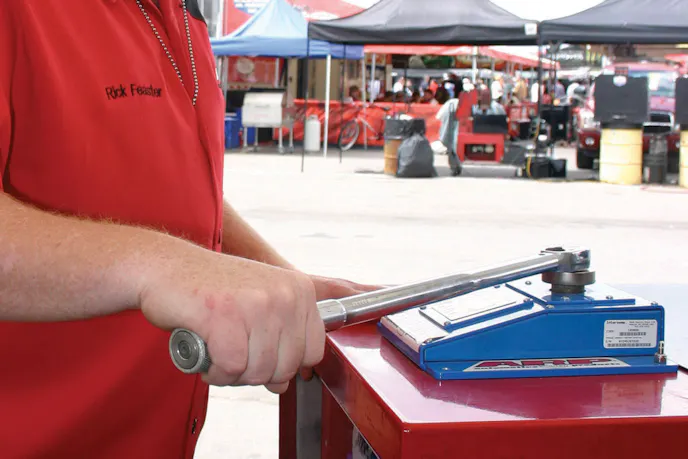
So it’s important to periodically test your torque wrench for accuracy. There’s one easy way to verify that a rod bolt is properly preloaded — measuring its stretch. All fasteners act like “springs” that are stretched to provide a rebounding force. For example, a typical small-block Chevy 3/8-inch rod bolt needs to be stretched .0055-inch to .0006-inch to achieve 10,000 lbs. clamping force. ARP includes the amount of stretch required in the instructions included with each rod bolt kit. They area also available online.
To facilitate accurately measuring the bolts ARP offers three stretch gauges that range from an analog dial indicator type to a digital model that reads in increments of .0005-inch.
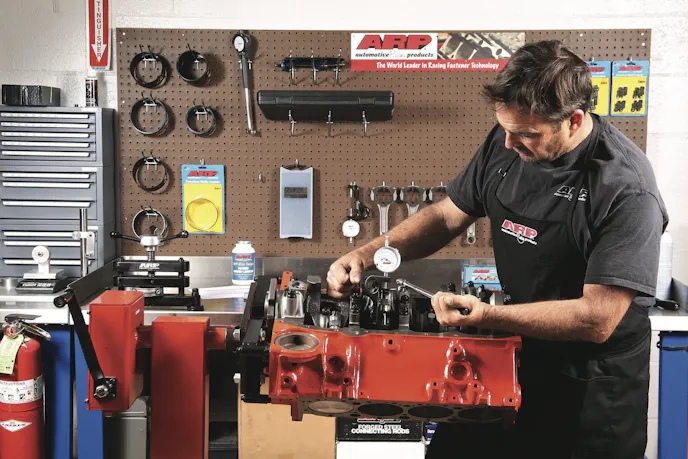
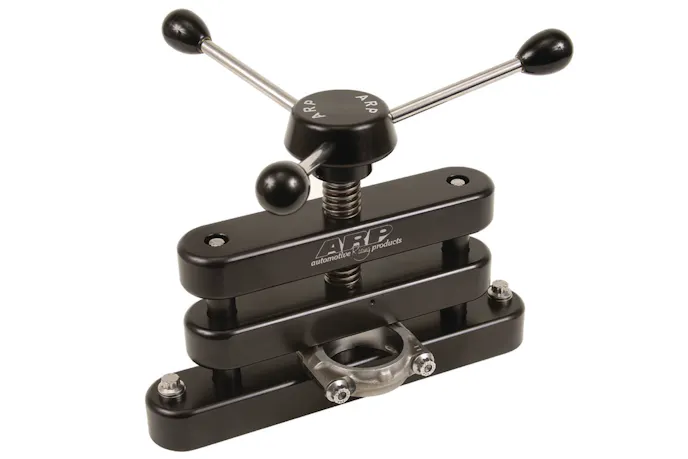
ARP recommends measuring the relaxed length of each rod bolt prior to assembly and putting the data in a chart for future reference. You’ll find a Rod Bolt Length Monitoring Chart on page 54 of the catalog. Upon disassembling the engine measure the bolts again. If any have stretched .001-inch or more they have been compromised and should be replace. Engine builders wishing to efficiently check bearing clearances of new or resized connecting rods prior to installation in the engine can use a handy Rod Vise offered by ARP.
Installing The Rod/Piston Assembly
When installing the connecting rod/piston assembly in the block it’s recommended to empty Rod Bolt Extension to help guide the rod in place and prevent nicking or scratching the crankshaft journals. Many of these extensions will also hold the rod bearing in place. They’re color coded for ease of identification.

Speaking of easy identification, ARP’s comprehensive lineup of CNC-machined 6061-T6 billet aluminumTapered Ring Compressors have their bore size prominently engraved to facilitate selection. They feature a true radius to gently squeeze the rings into their grooves for an effortless, safe installation and are also relieved to accommodate wire O-rings. ARP offers over 150 bore sizes ranging from 3.552- to 4.750-in SAE or metric from 75mm to 100mm. New sizes are continually being added.
Checking the piston ring end gap prior to assembly is facilitated by employing ARP’s Ring Squaring Tools. Each tool is double-sided to allow use with multiple ring bores. They range from 3.150-inch to 4.800-inch SAE and 80mm to 122mm metric.
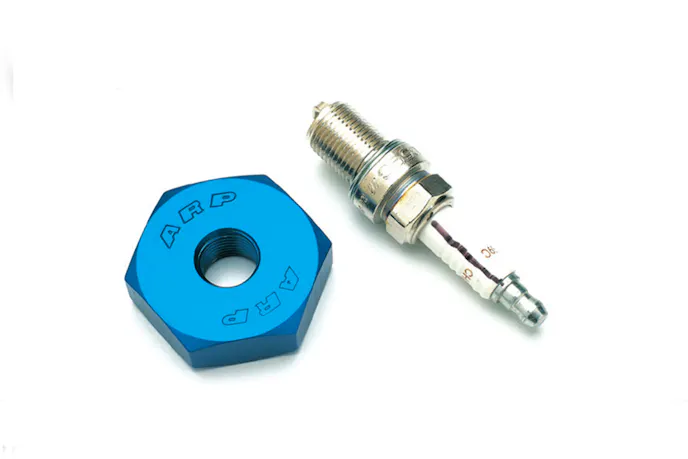
ARP also manufactures a Spark Plug Indexer that lets to position the ground electrode of the spark plug in combustion chambers where piston-to-dome clearances are critical. It also serves to proof the quality of the spark plug threads before endeavoring to install them in expensive aluminum cylinder heads. Accurately assembling engines will get you so far. Indexing your plugs will take you just a little bit further.

The final ARP tools for the serious engine builder are Oil Pump Primer Kits that allow you to spin the oil pump with an electric drill motor and pre-lube the engine to avoid any potential damage. They’re available for Ford and Chevy applications. Details are available in the latest ARP catalog, which can easily be accessed at www.ARPcatalog.com. A printed version of the 180-page publication is available upon request by visiting www.ARP-bolts.com.
You might also like
Sick Matching-Numbers Mopars Sold At Barrett-Jackson 2026 Las Vegas
Rare vintage Mopars dominated the Barrett-Jackson 2026 Las Vegas auction. Bidders fought over matching-numbers Cudas and Dodge Daytonas.