
Few garage arguments have aged as well as the one about vacuum secondaries versus mechanical secondaries. Somebody at every cruise night swears a double-pumper is the only real carburetor. Somebody else insists it will bog a street car into the next ZIP code. The truth is that neither side wins every time, because the right answer depends on what the engine was built to do. How the back two barrels get the message to open changes how the whole combination drives. That makes the secondary system just as important as any other part of matching a carburetor to the build.
Similar Specs, Different Purposes
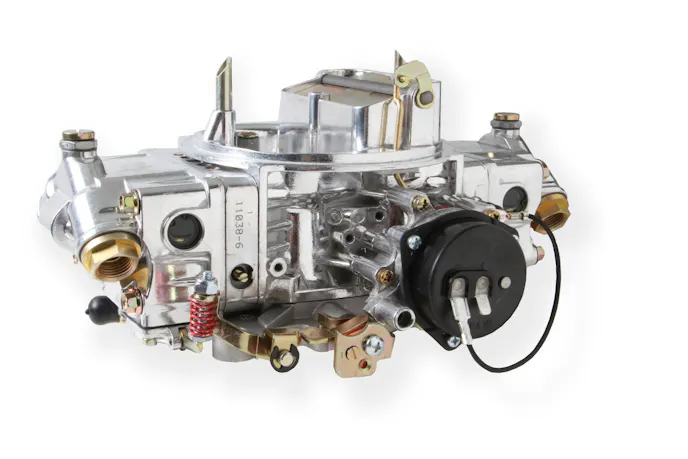
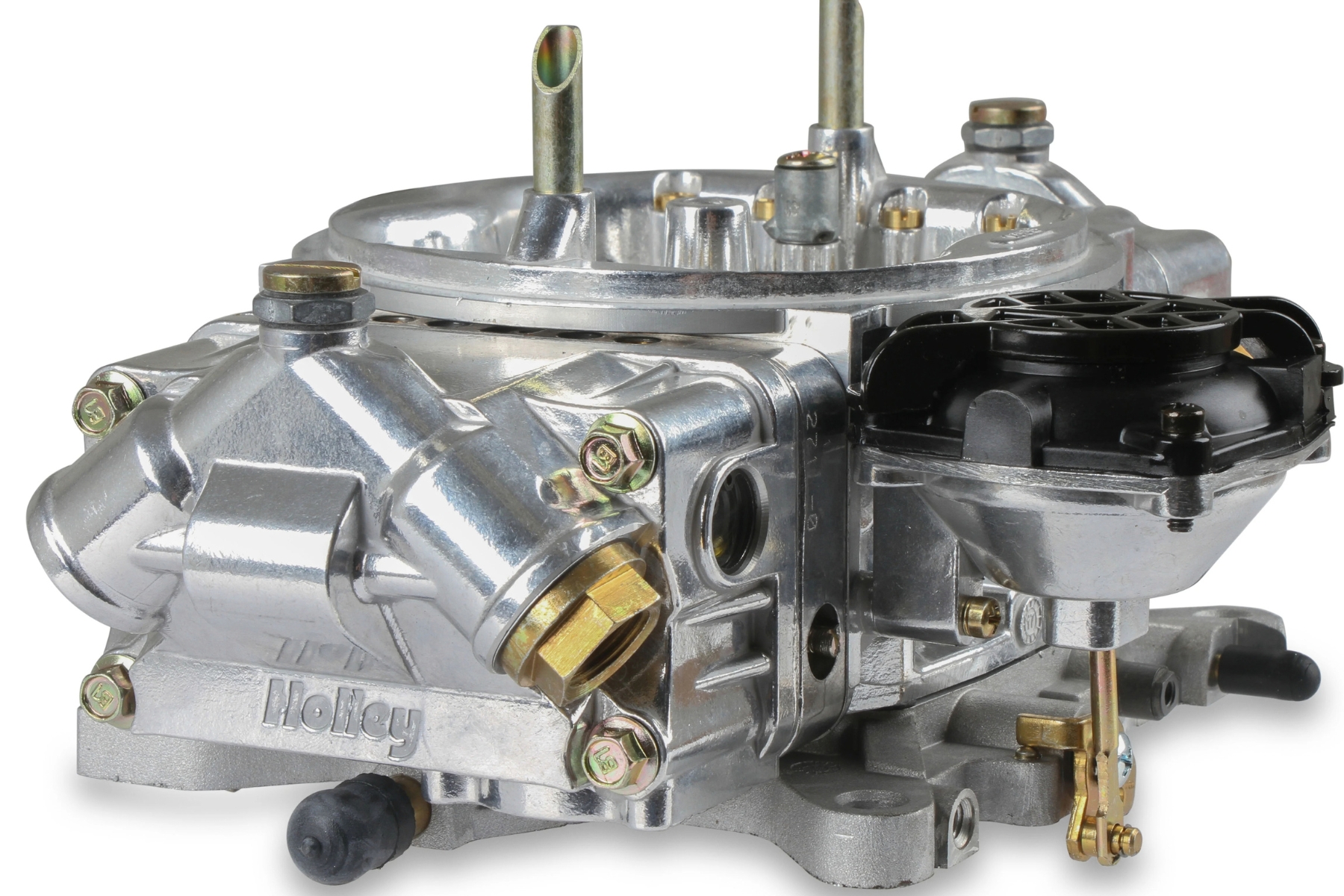
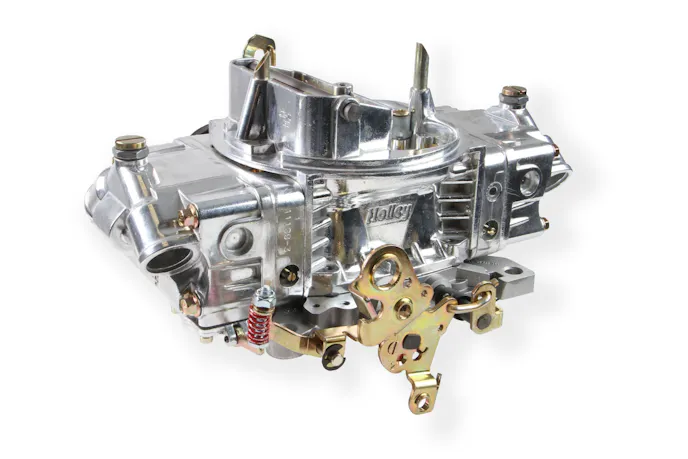
A good way to see the difference is to line up two Holley carburetors that are nearly twins on paper. The Aluminum Street HP (P/N 0-82750SA) uses vacuum secondaries. The Aluminum Double Pumper (P/N 0-4779SAE) uses mechanical secondaries. Both are 4150-style carburetors with polished aluminum bodies, and both share the same 1.688-inch primary throttle bores and 1.375-inch primary venturis. They even use the same dual 5/8-18 inverted-flare fuel inlets and square 5-1/8-inch air cleaner flange.
From there, the purposes split. According to Holley, the Street HP combines the best features of its race-bred 4150 HP carburetors, tamed for street and light competition use. Meanwhile, Holley calls the Double Pumper “a perfect performance upgrade for hot street cars and race vehicles.” The calibrations reflect that. The Street HP ships with a 77 primary jet, a 31 primary pump nozzle, and a 4.5 power valve. The Double Pumper runs a 70 primary jet, an 81 secondary jet, 28 and 31 pump nozzles, and a 6.5 power valve. The biggest difference, though, is when the secondaries open and who makes that call.
How Vacuum Secondaries Decide For Themselves
On a vacuum secondary Holley, the gas pedal only talks directly to the primaries. The secondary throttle plates are controlled by a diaphragm, and Holley’s Inside Your Holley Carburetor guide explained that “the opening rate of a vacuum secondary system is controlled by the diaphragm spring located in the vacuum secondary diaphragm housing.” As airflow through the primaries builds, the vacuum signal gets strong enough to overcome that spring. At that point, the secondaries start opening. In short, the engine decides when it can use the back half of the carburetor.
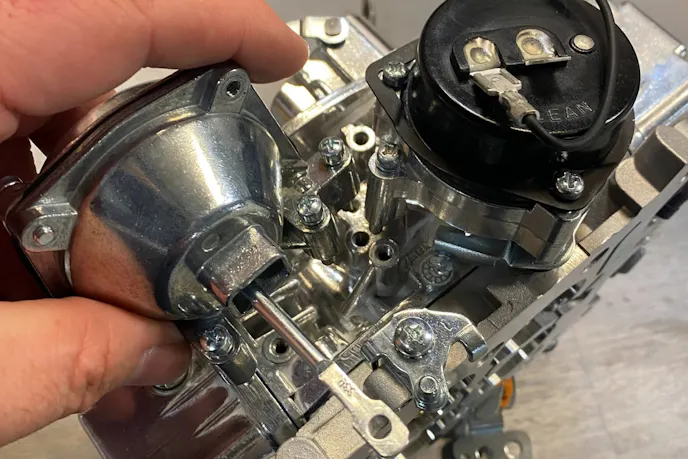
Holley is blunt about why it bothers with all that hardware. In the instructions for its Model 4150 HP Series carburetors, the company wrote, “if we could make our vacuum operated secondary carburetors perform better by opening the secondaries mechanically, it would be to our advantage to do so since all that vacuum actuating hardware is expensive and requires much time and money to calibrate.” The same sheet laid out the rule plainly: “The secondaries must not open until the engine requires the additional air.”
That also explains the famous seat-of-the-pants “kick.” Holley’s 4150 HP instructions stated that “those who ‘feel’ a kick when the secondaries engage are actually feeling a flat spot during initial acceleration because the secondaries have already begun to open and have weakened the fuel delivery signal to the primary boosters.” In other words, the kick most people brag about is actually a stumble wearing a nice jacket.
This is also why revving a parked car tells you very little about vacuum secondaries. Holley’s 4150 HP instructions said that “secondaries should open only when the engine is under a load,” and they warned owners not to expect to “wing” the throttle in the driveway and see the secondaries move. Holley’s spring kit instructions add that a small metal ball inside the system restricts vacuum flow on purpose. Pull it out, and Holley said the secondaries will “more or less flop open,” which defeats the whole point of vacuum secondaries.
Tuning Vacuum Secondaries With Springs
The main tuning tool is the diaphragm spring. Holley’s Secondary Diaphragm Spring Kit (P/N 20-13) includes a chart showing how each color changes the opening points. On a 350 ci engine, the purple spring starts opening the secondaries around 1,915 rpm. It reaches full opening around 6,950 rpm. The plain spring moves those points to 2,240 and 8,160 rpm. Meanwhile, the heavy black spring never fully opens on either the 350 or 402 ci examples in the chart.
Holley’s kit instructions describe a simple process. Start with a baseline, then try progressively lighter springs until a flat spot shows up. Once it does, go back to the previous, stiffer spring. Holley also recommended using a stopwatch, since “small gains in acceleration cannot be felt by the seat of the pants.” Weight matters too, and the 4150 HP instructions noted that “heavier cars require stiffer secondary diaphragm springs than light cars.” Finally, don’t clip a spring to make it lighter. Holley warned that “clipping springs actually increases spring rate and will delay opening.”
There’s one more rule for vacuum secondaries. Holley’s Inside Your Holley Carburetor guide warned, “DO NOT put a screw in the linkage of a vacuum secondary carburetor to mechanically ‘force’ open the secondary throttle plates.” According to Holley, that trick can cause lean conditions, backfires, and throttle binding.
Why Mechanical Secondaries Put You In Charge
Mechanical secondaries skip the negotiation entirely. Holley’s Inside Your Holley Carburetor guide explained that “the opening rate of a mechanical secondary system is pre-determined by the linkage which is usually designed to allow the secondary throttle plates to begin opening once the primary throttle plates have rotated open about 40 degrees.” Once the pedal gets there, the secondaries follow. It doesn’t matter whether the engine is ready for that air.
That’s where the “double” in double-pumper earns its name. According to the same guide, “the purpose of the secondary pump is to inject additional fuel to ‘cover’ the transition time up to the point when the secondary main system starts to flow.” Holley’s High Performance Tuning Instructions put it even more directly: “Mechanical secondary carburetors all utilize a secondary pump shot to prevent bogging when the secondaries are opened.” On the Double Pumper, Holley lists dual accelerator pumps for additional fuel under initial acceleration, along with four-corner idle adjustment.
The trade-off is that the secondary pump becomes part of the tuning job. Holley’s tuning instructions noted that “differences in vehicle weight, transmissions, and rear axle ratios affect the amount of fuel and the delivery rate.” So, a double-pumper’s pump shot needs to match the car it lives in.
Matching Secondaries To The Engine’s Job
Vacuum secondaries make the most sense when the engine can’t always use a big gulp of air on demand. Heavier cars, milder combinations, and street-driven builds benefit because the carb waits for real airflow before bringing in the secondaries. Holley’s spring guidance supports that approach, since heavier cars get stiffer springs to delay opening. A vacuum secondary carb also lets you tune the opening point with a spring swap instead of chasing a second pump shot. That lines up with Holley’s pitch for the Street HP as a carb tamed for the street and light competition.
Mechanical secondaries fit the build where the engine is ready for air almost as soon as the driver asks for it. Think of a lightweight car with a manual transmission, or an automatic with a high-stall converter and low gearing, where the engine climbs through the RPM range quickly. Holley lists exactly that kind of vehicle for its Double Pumper. In that setup, the mechanical linkage hands the decision to your right foot, and the secondary pump covers the gap. It expects the gearing, converter, and tune to hold up their end of the deal.
Either way, the carburetor should suit the engine’s purpose rather than the loudest opinion at the cruise night, and the secondary system is a big part of that match. Holley made it clear that proper opening beats early opening, so plan on some stopwatch time before the first real pass.
You might also like
Understanding The Included Wiring And Parts For SPAL Brushless Fans
SPAL brushless fans ship with an extended wire harness. Tom Longo breaks down standard factory hardware and optional wiring kits.